Skip to content
Love Beyond Words - autismwords.com Love Beyond Words - autismwords.com Love Beyond Words - autismwords.com

Supporting children with autism through education and care

Love Beyond Words - autismwords.com Love Beyond Words - autismwords.com Love Beyond Words - autismwords.com

Supporting children with autism through education and care

  • Learning & Support
    • Communication Skills
    • Daily Living Skills
    • Emotional Regulation
    • Everyday Challenges
    • Learning Through Play
    • Parent Education & Advocacy
    • Positive Behavior Support
    • Routines & Transitions
    • Social Skills
    • Speech & Language
  • Autism News & Perspectives
  • Learning & Support
    • Communication Skills
    • Daily Living Skills
    • Emotional Regulation
    • Everyday Challenges
    • Learning Through Play
    • Parent Education & Advocacy
    • Positive Behavior Support
    • Routines & Transitions
    • Social Skills
    • Speech & Language
  • Autism News & Perspectives
Close

Search

  • https://www.facebook.com/
  • https://twitter.com/
  • https://t.me/
  • https://www.instagram.com/
  • https://youtube.com/
Love Beyond Words - autismwords.com Love Beyond Words - autismwords.com Love Beyond Words - autismwords.com

Supporting children with autism through education and care

Love Beyond Words - autismwords.com Love Beyond Words - autismwords.com Love Beyond Words - autismwords.com

Supporting children with autism through education and care

  • Learning & Support
    • Communication Skills
    • Daily Living Skills
    • Emotional Regulation
    • Everyday Challenges
    • Learning Through Play
    • Parent Education & Advocacy
    • Positive Behavior Support
    • Routines & Transitions
    • Social Skills
    • Speech & Language
  • Autism News & Perspectives
  • Learning & Support
    • Communication Skills
    • Daily Living Skills
    • Emotional Regulation
    • Everyday Challenges
    • Learning Through Play
    • Parent Education & Advocacy
    • Positive Behavior Support
    • Routines & Transitions
    • Social Skills
    • Speech & Language
  • Autism News & Perspectives
Close

Search

  • https://www.facebook.com/
  • https://twitter.com/
  • https://t.me/
  • https://www.instagram.com/
  • https://youtube.com/
Home/Learning & Support/Communication Skills/Taking Turns: 6 Essential Communication Phrases for Young Children
Taking Turns: 6 Essential Communication Phrases for Young Children
Communication Skills

Taking Turns: 6 Essential Communication Phrases for Young Children

August 22, 2026 2 Min Read
0

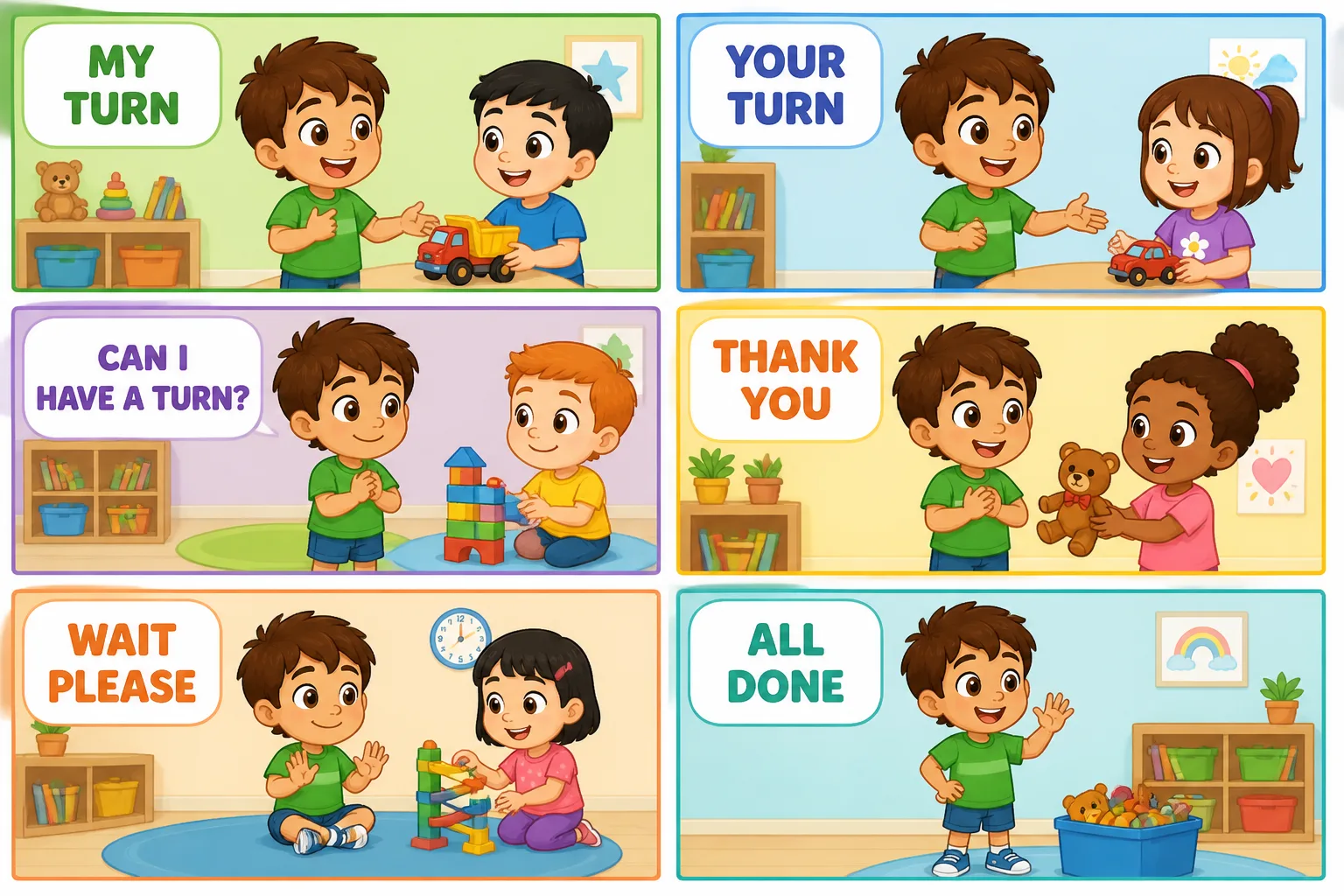
Teaching young children how to take turns is a vital social communication skill that helps them engage positively with peers, share resources, and build friendships. This set of 6 essential communication phrases for taking turns equips children with practical words and gestures they can use in everyday play or classroom settings to express their needs and respect others.

Why Teach Taking Turns Communication?

Taking turns is more than just waiting; it involves recognizing others’ needs, managing impulses, and using language or alternative communication methods to negotiate playtime. Children who learn to communicate about turns effectively are better able to participate in group activities and develop social confidence.

6 Practical Phrases for Taking Turns

  • MY TURN – Used when the child wants to have a turn with a toy or activity.
  • YOUR TURN – Indicates the child is giving the turn to someone else.
  • CAN I HAVE A TURN? – A polite request to join in or use a toy.
  • THANK YOU – Expresses gratitude after receiving a turn.
  • WAIT PLEASE – Helps the child ask for patience while waiting.
  • ALL DONE – Signals the child has finished and is ready to pass the turn.

How Parents Can Practice These Phrases Naturally

Model these phrases during everyday play without forcing repetition. When playing with your child or siblings, narrate your actions: say “Your turn,” then “My turn,” and encourage your child to try the phrases by giving them real opportunities to request or give turns. Use gestures, pointing, or picture cards alongside words to support understanding. Offer simple choices like “Do you want to wait or have a turn now?” and pause to allow your child time to respond. Celebrate all attempts at communication to build confidence and positive associations.

For more helpful communication phrases, you might also find our posts on Making Choices and Asking for a Break useful.

Try It Today!

Next time your child plays with others, encourage them to use these phrases to take turns. How does your child like to ask for a turn? Share your experiences below!

Download the images in this article

  • Taking Turns: 6 Essential Communication Phrases for Young Children

Tags:

communication phrasesFunctional Communicationplaytime communicationsharingsocial skillstaking turnsyoung children
Other Articles
Bedtime Routine Visual Learning Set: 6 Steps to Help Your Child Build
Previous

Bedtime Routine Visual Learning Set: 6 Steps to Help Your Child Build Independence

Key Insights from ASF at INSAR 2023 Highlight Diversity and Inclusion in
Next

Key Insights from ASF at INSAR 2023 Highlight Diversity and Inclusion in Autism Research

No Comment! Be the first one.

Leave a Reply Cancel reply

Your email address will not be published. Required fields are marked *

AAC asking for a break asking for help autism education autism parenting autism research Autism Science Foundation autism spectrum disorder autism support child development child independence children's feelings child transitions communication communication phrases communication skills coping strategies daily living skills emotional regulation everyday challenges fine motor skills Functional Communication Gross Motor Skills IEP support language development learning through play parent advocacy parenting tips parent preparation positive behavior support predictable routines problem solving replacement skills school accommodations school support self-advocacy sensory breaks sensory support special education speech and language visual learning visual learning set visual routine visual supports young children

  • Advancing Sleep Care in Children with Neurodevelopmental Disorders Through Phenotype-Focused Approaches
    Advancing Sleep Care in Children with Neurodevelopmental Disorders Through Phenotype-Focused Approaches
    Sleep disturbances are common in children with neurodevelopmental disorders, but diagnosis alone offers limited treatment guidance. A phenotype-focused approach may improve care.
  • Study Reveals Varied Preferences for Autism Terminology Among Autistic Individuals and Parents
    Study Reveals Varied Preferences for Autism Terminology Among Autistic Individuals and Parents in the U.S.
    A U.S. study of over 5,000 participants reveals diverse preferences for autism-related terminology, highlighting the importance of respectful, individualized language use.
  • Virtual Caregiver-Led Autism Intervention Adapted for Spanish-Speaking Families Shows Promise
    Virtual Caregiver-Led Autism Intervention Adapted for Spanish-Speaking Families Shows Promise
    A newly adapted virtual caregiver-led intervention shows potential in supporting Spanish-speaking families of children with autism by incorporating cultural and linguistic considerations.
  • Handling Disagreement: 6 Clear Steps to Support Your Child's Social Skills
    Handling Disagreement: 6 Clear Steps to Support Your Child’s Social Skills
    Teach your child 6 clear steps to handle disagreement calmly and respectfully: notice the problem, pause, say what happened, ask for space or help, choose a solution, and return when ready.
  • Pediatric Primary Care Network Integrates Autism Spectrum Disorder Evaluation and Support Services
    Pediatric Primary Care Network Integrates Autism Spectrum Disorder Evaluation and Support Services
    A new pediatric primary care model integrates autism spectrum disorder evaluation with postdiagnostic support, aiming to improve access and continuity of care for families.
Basic Requests: 6 Essential Communication Phrases for Young Children
August 24, 2026
Making Choices: 6 Essential Communication Phrases for Young Children
August 21, 2026
Asking for a Break: 6 Essential Communication Phrases for Young Children
August 21, 2026
Expressing Discomfort and Asking for Help: 6 Essential Communication Phrases for Young
Expressing Discomfort and Asking for Help: 6 Essential Communication Phrases for Young Children
August 21, 2026
Expressing Discomfort and Asking for Help: 6 Essential Communication Phrases for Young
Expressing Discomfort and Asking for Help: 6 Essential Communication Phrases for Young Children
47 views
Preparing for Loud Events: 6 Sensory Support Steps for Children
47 views
Preparing for an IEP Meeting: 6 Essential Parent Steps for Success
37 views
Using a Calm Voice: 5 Positive Steps for Young Children
34 views
Color Sorting Treasure Hunt: A Fun Learning Through Play Activity
34 views

Content on this website is created with the assistance of artificial intelligence (AI), while some portions are still reviewed and overseen by humans. All content and resources are provided completely free of charge.

Some information may be referenced or cited from reputable sources. Whenever possible, we will clearly identify the sources used within each article.

If you have any questions, feedback, or would like to contact us, please email: info@autismwords.com

Copyright 2026 — Love Beyond Words - autismwords.com. All rights reserved. Blogsy WordPress Theme

Join Us on the Journey to Understanding Autism

Subscribe to receive curated autism knowledge, lessons, and the latest news — delivered to you regularly.

We promise to send only helpful autism-related information and knowledge — no ads, no spam. You can unsubscribe anytime.

Thank you for subscribing!