
Skip to content
Love Beyond Words - autismwords.com Love Beyond Words - autismwords.com Love Beyond Words - autismwords.com

Supporting children with autism through education and care

Love Beyond Words - autismwords.com Love Beyond Words - autismwords.com Love Beyond Words - autismwords.com

Supporting children with autism through education and care

  • Learning & Support
    • Communication Skills
    • Daily Living Skills
    • Emotional Regulation
    • Everyday Challenges
    • Learning Through Play
    • Parent Education & Advocacy
    • Positive Behavior Support
    • Routines & Transitions
    • Social Skills
    • Speech & Language
  • Autism News & Perspectives
  • Learning & Support
    • Communication Skills
    • Daily Living Skills
    • Emotional Regulation
    • Everyday Challenges
    • Learning Through Play
    • Parent Education & Advocacy
    • Positive Behavior Support
    • Routines & Transitions
    • Social Skills
    • Speech & Language
  • Autism News & Perspectives
Close

Search

  • https://www.facebook.com/
  • https://twitter.com/
  • https://t.me/
  • https://www.instagram.com/
  • https://youtube.com/
Love Beyond Words - autismwords.com Love Beyond Words - autismwords.com Love Beyond Words - autismwords.com

Supporting children with autism through education and care

Love Beyond Words - autismwords.com Love Beyond Words - autismwords.com Love Beyond Words - autismwords.com

Supporting children with autism through education and care

  • Learning & Support
    • Communication Skills
    • Daily Living Skills
    • Emotional Regulation
    • Everyday Challenges
    • Learning Through Play
    • Parent Education & Advocacy
    • Positive Behavior Support
    • Routines & Transitions
    • Social Skills
    • Speech & Language
  • Autism News & Perspectives
  • Learning & Support
    • Communication Skills
    • Daily Living Skills
    • Emotional Regulation
    • Everyday Challenges
    • Learning Through Play
    • Parent Education & Advocacy
    • Positive Behavior Support
    • Routines & Transitions
    • Social Skills
    • Speech & Language
  • Autism News & Perspectives
Close

Search

  • https://www.facebook.com/
  • https://twitter.com/
  • https://t.me/
  • https://www.instagram.com/
  • https://youtube.com/
Home/Learning & Support/Everyday Challenges/When a Toy is Unavailable: 6 Helpful Steps for Kids to Cope
When a Toy is Unavailable: 6 Helpful Steps for Kids to Cope
Everyday Challenges

When a Toy is Unavailable: 6 Helpful Steps for Kids to Cope

August 24, 2026 2 Min Read
0

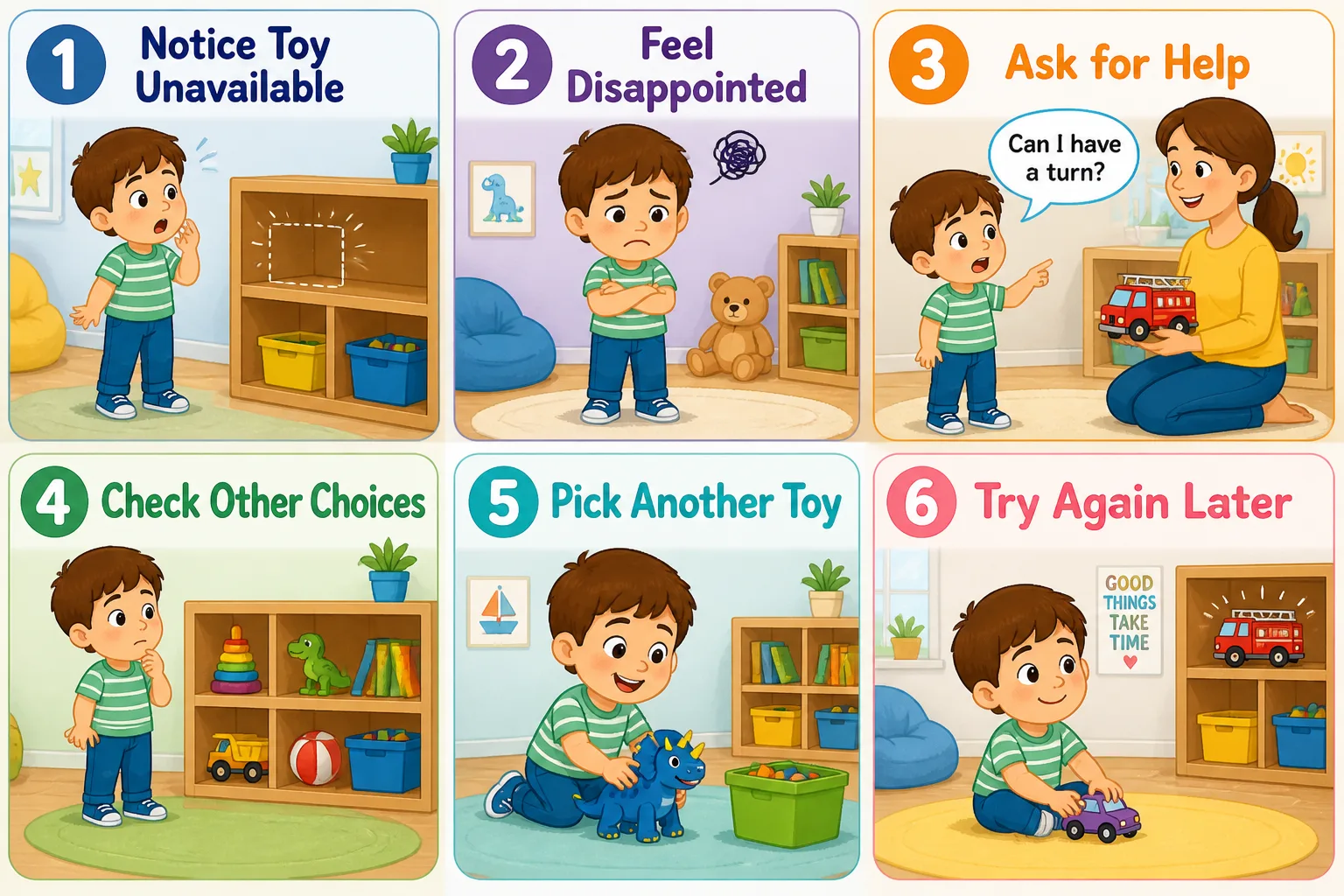
When a toy your child wants is unavailable, it can be a frustrating and confusing moment. This everyday challenge is common in homes, classrooms, and playgroups. Teaching children practical coping steps helps them understand their feelings, communicate their needs, and find positive alternatives. Here are 6 helpful steps to support your child when a toy is not available.

1. Notice Toy Unavailable

Help your child recognize the situation by calmly pointing out that the toy is not there or is being used by someone else. This awareness is the first step toward coping.

2. Feel Disappointed

It’s okay for children to feel sad or frustrated. Acknowledge their feelings without judgment. Saying something like, “I see you’re upset because the toy isn’t here,” validates their emotions.

3. Ask for Help

Encourage your child to communicate their need by asking an adult or caregiver for help. This can be through words, gestures, or AAC methods. For example, “Can I have help finding another toy?”

4. Check Other Choices

Guide your child to look at other available toys or activities. Offering two realistic options can empower them to make a choice without feeling overwhelmed.

5. Pick Another Toy

Support your child in selecting an alternative toy or activity. Celebrate this choice to reinforce positive problem-solving.

6. Try Again Later

Help your child understand that they can return to the preferred toy later. Using a timer or a visual schedule can assist in managing expectations.

Parents can support this process by previewing play situations, using simple language, and modeling helpful phrases like “Can I try again later?” or “Different please.” Allow your child time to process and offer breaks if needed. Avoid pressure or shaming, and remember that practice helps build flexibility and communication skills.

For related strategies on coping with disappointment and flexibility, see Changing Plans: 6 Helpful Steps for Kids to Cope and When I Make a Mistake: 6 Steps to Help Kids Cope.

Parent question: What other choices or phrases help your child when a favorite toy isn’t available?

Download the images in this article

  • When a Toy is Unavailable: 6 Helpful Steps for Kids to Cope

Tags:

autism supportchild flexibilitycommunication skillscoping with disappointmenteveryday challengesproblem solvingtoy unavailable coping steps
Other Articles
Study Evaluates Four Strategies to Reduce Resurgence of Destructive Behavior Based on
Previous

Study Evaluates Four Strategies to Reduce Resurgence of Destructive Behavior Based on Behavioral Momentum Theory

Integrating Agentic AI into Neuroscience Research: Guidelines and Considerations
Next

Integrating Agentic AI into Neuroscience Research: Guidelines and Considerations

No Comment! Be the first one.

Leave a Reply Cancel reply

Your email address will not be published. Required fields are marked *

AAC asking for a break asking for help autism education autism parenting autism research Autism Science Foundation autism spectrum disorder autism support child development child independence children's feelings child transitions communication communication phrases communication skills coping strategies daily living skills emotional regulation everyday challenges fine motor skills Functional Communication Gross Motor Skills hygiene routine IEP support language development learning through play parent advocacy parenting tips parent preparation positive behavior support predictable routines problem solving replacement skills school accommodations school support self-advocacy sensory breaks sensory support speech and language visual learning visual learning set visual routine visual supports young children

  • Teaching WH Questions: 6 Simple Examples for Young Children
    Teaching WH Questions: 6 Simple Examples for Young Children
    Learn how to teach young children important WH questions like who, what, where, when, why, and how with 6 simple visual examples and practical tips for parents.
  • Advancing Sleep Care in Children with Neurodevelopmental Disorders Through Phenotype-Focused Approaches
    Advancing Sleep Care in Children with Neurodevelopmental Disorders Through Phenotype-Focused Approaches
    Sleep disturbances are common in children with neurodevelopmental disorders, but diagnosis alone offers limited treatment guidance. A phenotype-focused approach may improve care.
  • Study Reveals Varied Preferences for Autism Terminology Among Autistic Individuals and Parents
    Study Reveals Varied Preferences for Autism Terminology Among Autistic Individuals and Parents in the U.S.
    A U.S. study of over 5,000 participants reveals diverse preferences for autism-related terminology, highlighting the importance of respectful, individualized language use.
  • Virtual Caregiver-Led Autism Intervention Adapted for Spanish-Speaking Families Shows Promise
    Virtual Caregiver-Led Autism Intervention Adapted for Spanish-Speaking Families Shows Promise
    A newly adapted virtual caregiver-led intervention shows potential in supporting Spanish-speaking families of children with autism by incorporating cultural and linguistic considerations.
  • Handling Disagreement: 6 Clear Steps to Support Your Child's Social Skills
    Handling Disagreement: 6 Clear Steps to Support Your Child’s Social Skills
    Teach your child 6 clear steps to handle disagreement calmly and respectfully: notice the problem, pause, say what happened, ask for space or help, choose a solution, and return when ready.
When I Make a Mistake: 6 Steps to Help Kids Cope
August 22, 2026
Being Told to Wait: 6 Helpful Steps for Kids to Cope
August 21, 2026
Changing Plans: 6 Helpful Steps for Kids to Cope
August 20, 2026
Expressing Discomfort and Asking for Help: 6 Essential Communication Phrases for Young
Expressing Discomfort and Asking for Help: 6 Essential Communication Phrases for Young Children
47 views
Preparing for Loud Events: 6 Sensory Support Steps for Children
47 views
Preparing for an IEP Meeting: 6 Essential Parent Steps for Success
37 views
Using a Calm Voice: 5 Positive Steps for Young Children
34 views
Color Sorting Treasure Hunt: A Fun Learning Through Play Activity
34 views

Content on this website is created with the assistance of artificial intelligence (AI), while some portions are still reviewed and overseen by humans. All content and resources are provided completely free of charge.

Some information may be referenced or cited from reputable sources. Whenever possible, we will clearly identify the sources used within each article.

If you have any questions, feedback, or would like to contact us, please email: info@autismwords.com

Copyright 2026 — Love Beyond Words - autismwords.com. All rights reserved. Blogsy WordPress Theme

Join Us on the Journey to Understanding Autism

Subscribe to receive curated autism knowledge, lessons, and the latest news — delivered to you regularly.

We promise to send only helpful autism-related information and knowledge — no ads, no spam. You can unsubscribe anytime.

Thank you for subscribing!