Skip to content
Love Beyond Words - autismwords.com Love Beyond Words - autismwords.com Love Beyond Words - autismwords.com

Supporting children with autism through education and care

Love Beyond Words - autismwords.com Love Beyond Words - autismwords.com Love Beyond Words - autismwords.com

Supporting children with autism through education and care

  • Learning & Support
    • Communication Skills
    • Daily Living Skills
    • Emotional Regulation
    • Everyday Challenges
    • Learning Through Play
    • Parent Education & Advocacy
    • Positive Behavior Support
    • Routines & Transitions
    • Social Skills
    • Speech & Language
  • Autism News & Perspectives
  • Hero News
  • Learning & Support
    • Communication Skills
    • Daily Living Skills
    • Emotional Regulation
    • Everyday Challenges
    • Learning Through Play
    • Parent Education & Advocacy
    • Positive Behavior Support
    • Routines & Transitions
    • Social Skills
    • Speech & Language
  • Autism News & Perspectives
  • Hero News
Close

Search

  • https://www.facebook.com/
  • https://twitter.com/
  • https://t.me/
  • https://www.instagram.com/
  • https://youtube.com/
Love Beyond Words - autismwords.com Love Beyond Words - autismwords.com Love Beyond Words - autismwords.com

Supporting children with autism through education and care

Love Beyond Words - autismwords.com Love Beyond Words - autismwords.com Love Beyond Words - autismwords.com

Supporting children with autism through education and care

  • Learning & Support
    • Communication Skills
    • Daily Living Skills
    • Emotional Regulation
    • Everyday Challenges
    • Learning Through Play
    • Parent Education & Advocacy
    • Positive Behavior Support
    • Routines & Transitions
    • Social Skills
    • Speech & Language
  • Autism News & Perspectives
  • Hero News
  • Learning & Support
    • Communication Skills
    • Daily Living Skills
    • Emotional Regulation
    • Everyday Challenges
    • Learning Through Play
    • Parent Education & Advocacy
    • Positive Behavior Support
    • Routines & Transitions
    • Social Skills
    • Speech & Language
  • Autism News & Perspectives
  • Hero News
Close

Search

  • https://www.facebook.com/
  • https://twitter.com/
  • https://t.me/
  • https://www.instagram.com/
  • https://youtube.com/
Home/Learning & Support/Parent Education & Advocacy/Advocating for Your Child’s Participation in School Activities: A Practical Parent Guide
Advocating for Your Child's Participation in School Activities: A Practical Parent Guide
Parent Education & Advocacy

Advocating for Your Child’s Participation in School Activities: A Practical Parent Guide

By Sophia Le
September 23, 2026 3 Min Read
0

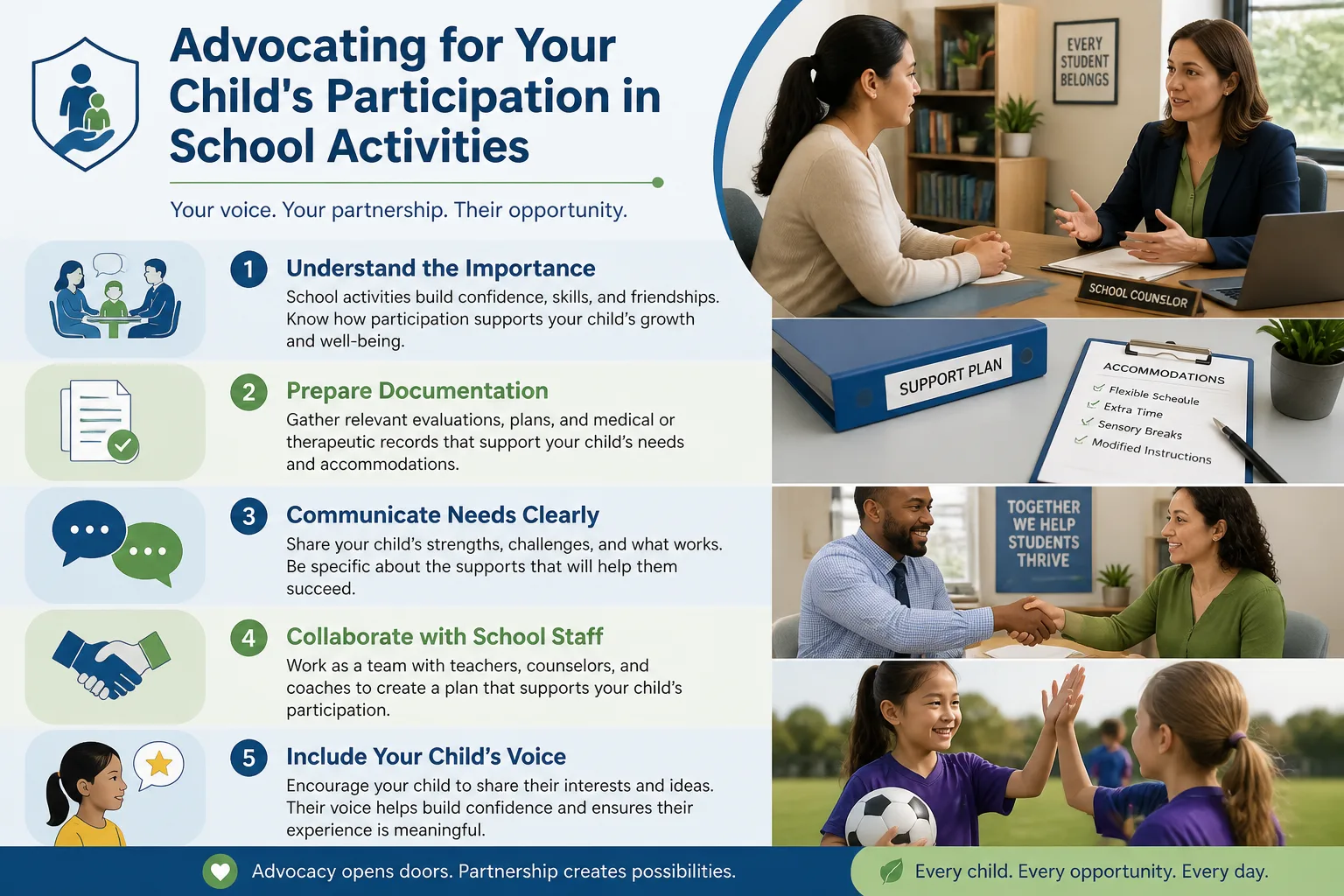
Advocating for your child’s participation in school activities is a vital aspect of supporting their social development, inclusion, and overall well-being. For parents of autistic children or those with additional support needs, ensuring access to extracurricular activities can sometimes be challenging, yet it is essential for fostering friendships, building confidence, and enhancing communication skills.

Why Advocating for Participation Matters

School activities such as clubs, sports, arts, and social groups offer opportunities beyond academics that help children develop social skills, sensory regulation, and a sense of belonging. However, children with autism or sensory and communication differences may face barriers such as lack of accommodations, misunderstandings, or exclusion. Advocacy helps ensure your child’s dignity and needs are respected, enabling meaningful participation.

Common Challenges Parents May Encounter

  • Lack of awareness or training: School staff may not fully understand your child’s sensory or communication needs.
  • Inadequate accommodations: Activities may not be adapted for sensory sensitivities or communication preferences.
  • Social exclusion or bullying fears: Concerns about your child’s safety or acceptance may arise.
  • Limited communication: Your child’s preferred communication method (AAC, gestures, sign) might not be supported during activities.

Preparing to Advocate Effectively

Preparation is key to successful advocacy. Consider these steps:

  • Document your child’s strengths and needs: Keep notes on what activities your child enjoys or shows interest in, along with any sensory or communication supports they require.
  • Gather relevant reports: Bring recent evaluations, therapy notes, or IEP/504 plans that describe accommodations and goals related to social participation.
  • Observe and record: If your child has tried activities before, note what worked well and what challenges occurred.
  • Learn about the activity: Understand the structure, environment, and typical demands of the activity to identify potential barriers.

Questions to Ask School Staff

When discussing your child’s participation with teachers, coaches, or activity leaders, consider asking:

  • “How are sensory and communication needs typically supported in this activity?”
  • “What accommodations can be made to help my child participate comfortably and safely?”
  • “Are staff trained to support children with autism or communication differences?”
  • “How can we collaborate to include my child’s preferred communication methods?”
  • “What strategies are in place to prevent exclusion or bullying?”

Advocacy Strategies for Collaboration and Respect

Approach advocacy as a partnership with school staff, focusing on shared goals for your child’s success:

  • Use clear, respectful language: For example, “My child uses a communication device and benefits from quiet spaces during sensory overload. How can we support this in the club setting?”
  • Offer to provide resources or training: Share helpful materials about autism or communication supports if staff are unfamiliar.
  • Request measurable accommodations: Ask for specific supports documented in writing, such as “allowing use of noise-cancelling headphones” or “providing visual schedules.”
  • Include your child’s voice: When appropriate, ask your child what they want and how they prefer to participate. Share their input with staff.
  • Follow up in writing: Summarize conversations via email to create a record and clarify next steps.

Common Pitfalls to Avoid

  • Avoid assuming staff know your child’s needs without clear communication.
  • Don’t accept vague promises; seek written agreements on accommodations.
  • Refrain from pushing for participation that causes distress or discomfort to your child.
  • Don’t hesitate to seek additional professional advice or advocacy support if needed.

Including Your Child’s Voice and Respecting Autonomy

Whenever possible, involve your child in decisions about activities. Respect their preferences, communication style, and comfort level. This supports their dignity and fosters self-advocacy skills. For example, if your child uses AAC, encourage them to express what they enjoy or find challenging about an activity.

When to Seek Additional Guidance

If you encounter persistent barriers or feel your child is unfairly excluded, consider consulting a special education advocate, legal expert, or your child’s therapy team. Understanding your rights under laws like IDEA or Section 504 can empower you to request appropriate accommodations.

Key Takeaway

Advocating for your child’s participation in school activities is about preparing thoughtfully, communicating clearly, collaborating respectfully, and centering your child’s needs and voice. This approach helps ensure your child can enjoy meaningful, inclusive experiences that support their growth and happiness.

Have you noticed any particular school activities your child is interested in but hasn’t been able to join? What steps have you taken to support their participation?

Download the images in this article

  • Advocating for Your Child’s Participation in School Activities: A Practical Parent Guide

Tags:

advocating for your child's participation in school activitieschild participationcommunication supportsIEP advocacyparent advocacy autismschool accommodationsschool activities inclusionsensory accommodations
Author

Sophia Le

Follow Me
Other Articles
Study Reviews Link Between Prenatal Paracetamol Use and Neurodevelopmental Disorders in Children
Previous

Study Reviews Link Between Prenatal Paracetamol Use and Neurodevelopmental Disorders in Children

Study Explores Cognitive Aging in Autism: Evidence Suggests Unique Patterns
Next

Study Explores Cognitive Aging in Autism: Evidence Suggests Unique Patterns

No Comment! Be the first one.

Leave a Reply Cancel reply

Your email address will not be published. Required fields are marked *

ADHD ASD ASD research autism autism communication autism diagnosis autism parenting autism research autism spectrum disorder autism support autistic adults autistic children child communication child development child independence communication communication skills communication support communication supports communication tools coping strategies daily living skills early intervention emotional regulation fine motor skills Functional Communication intellectual disability language development learning through play mental health mouse model neurodevelopment neurodevelopmental disorders neurodiversity neuroinflammation parent advocacy positive behavior support sensory accommodations sensory needs sensory processing sensory support sex differences visual learning set visual routine young children

  • Halliwick Aquatic Therapy Linked to Improved Quality of Life in Children with
    Halliwick Aquatic Therapy Linked to Improved Quality of Life in Children with Autism Spectrum Disorder
    A study suggests that Halliwick-based aquatic physical activity may improve quality of life in children and adolescents with autism spectrum disorder, showing benefits in psychological well-being and autonomy.
  • New Insights into Autism: Linking Brain Fluid Dynamics and Network Development to
    New Insights into Autism: Linking Brain Fluid Dynamics and Network Development to Clinical Outcomes
    New research explores how brain fluid movement and neural network development may influence autism's clinical outcomes, offering insights into its diverse trajectories.
  • Study Links Perceived Stress and Auditory Sensitivity in Autistic and Non-Autistic University
    Study Links Perceived Stress and Auditory Sensitivity in Autistic and Non-Autistic University Students
    A study finds perceived stress is linked to auditory sensitivity in autistic and non-autistic university students, with autistic students showing higher sensitivity.
  • New Study Supports Reliable Autism Intervention Measures Across Clinic and Home Settings
    New Study Supports Reliable Autism Intervention Measures Across Clinic and Home Settings
    A recent study found that brief observational tools measuring social communication and caregiver strategies in young autistic children are reliable and feasible across both clinic and home settings, supporting flexible early intervention assessments.
  • Study Highlights Social Disadvantages Impacting Health of Autistic Adults Without Intellectual Disability
    Study Highlights Social Disadvantages Impacting Health of Autistic Adults Without Intellectual Disability
    A UK study finds autistic adults without intellectual disability face social disadvantages that contribute to higher chronic illness and mortality risks, highlighting the need for systemic policy changes.
Advocating for Your Child When They Experience Bullying at School: A Practical
Advocating for Your Child When They Experience Bullying at School: A Practical Parent Guide
September 25, 2026
Advocating for Your Child During School Evaluations: A Practical Parent Guide
September 20, 2026
Advocating for Your Child's Transition from Early Intervention to School Services: A
Advocating for Your Child’s Transition from Early Intervention to School Services: A Practical Parent Guide
September 18, 2026
Advocating for Your Child's Inclusion in School Activities: A Practical Parent Guide
Advocating for Your Child’s Inclusion in School Activities: A Practical Parent Guide
September 15, 2026
Study Reveals Sex-Specific Behavioral Changes in Mice Lacking α5-Nicotinic Acetylcholine Receptors
156 views
Preparing for Loud Events: 6 Sensory Support Steps for Children
137 views
Expressing Discomfort and Asking for Help: 6 Essential Communication Phrases for Young
Expressing Discomfort and Asking for Help: 6 Essential Communication Phrases for Young Children
131 views
Feeling Worried: 6 Steps to Help Young Children Recognize and Manage Worry
129 views
Using a Calm Voice: 5 Positive Steps for Young Children
127 views

Content on this website is created with the assistance of artificial intelligence (AI), while some portions are still reviewed and overseen by humans. All content and resources are provided completely free of charge.

Some information may be referenced or cited from reputable sources. Whenever possible, we will clearly identify the sources used within each article.

If you have any questions, feedback, or would like to contact us, please email: info@autismwords.com

Copyright 2026 — Love Beyond Words - autismwords.com. All rights reserved. Blogsy WordPress Theme

Join Us on the Journey to Understanding Autism

Subscribe to receive curated autism knowledge, lessons, and the latest news — delivered to you regularly.

We promise to send only helpful autism-related information and knowledge — no ads, no spam. You can unsubscribe anytime.

Thank you for subscribing!