Skip to content
Love Beyond Words - autismwords.com Love Beyond Words - autismwords.com Love Beyond Words - autismwords.com

Supporting children with autism through education and care

Love Beyond Words - autismwords.com Love Beyond Words - autismwords.com Love Beyond Words - autismwords.com

Supporting children with autism through education and care

  • Learning & Support
    • Communication Skills
    • Daily Living Skills
    • Emotional Regulation
    • Everyday Challenges
    • Learning Through Play
    • Parent Education & Advocacy
    • Positive Behavior Support
    • Routines & Transitions
    • Social Skills
    • Speech & Language
  • Autism News & Perspectives
  • Hero News
  • Learning & Support
    • Communication Skills
    • Daily Living Skills
    • Emotional Regulation
    • Everyday Challenges
    • Learning Through Play
    • Parent Education & Advocacy
    • Positive Behavior Support
    • Routines & Transitions
    • Social Skills
    • Speech & Language
  • Autism News & Perspectives
  • Hero News
Close

Search

  • https://www.facebook.com/
  • https://twitter.com/
  • https://t.me/
  • https://www.instagram.com/
  • https://youtube.com/
Love Beyond Words - autismwords.com Love Beyond Words - autismwords.com Love Beyond Words - autismwords.com

Supporting children with autism through education and care

Love Beyond Words - autismwords.com Love Beyond Words - autismwords.com Love Beyond Words - autismwords.com

Supporting children with autism through education and care

  • Learning & Support
    • Communication Skills
    • Daily Living Skills
    • Emotional Regulation
    • Everyday Challenges
    • Learning Through Play
    • Parent Education & Advocacy
    • Positive Behavior Support
    • Routines & Transitions
    • Social Skills
    • Speech & Language
  • Autism News & Perspectives
  • Hero News
  • Learning & Support
    • Communication Skills
    • Daily Living Skills
    • Emotional Regulation
    • Everyday Challenges
    • Learning Through Play
    • Parent Education & Advocacy
    • Positive Behavior Support
    • Routines & Transitions
    • Social Skills
    • Speech & Language
  • Autism News & Perspectives
  • Hero News
Close

Search

  • https://www.facebook.com/
  • https://twitter.com/
  • https://t.me/
  • https://www.instagram.com/
  • https://youtube.com/
Home/Learning & Support/Parent Education & Advocacy/Advocating for Your Child’s Transition from Early Intervention to School Services: A Practical Parent Guide
Advocating for Your Child's Transition from Early Intervention to School Services: A
Parent Education & Advocacy

Advocating for Your Child’s Transition from Early Intervention to School Services: A Practical Parent Guide

By Sarah Mitchell
September 18, 2026 4 Min Read
0

Transitioning your autistic child from early intervention (EI) services to school-based supports is a significant milestone that can feel overwhelming for many families. Understanding how to advocate effectively during this period ensures your child continues to receive the developmental, communication, and sensory support they need as they enter the school system. This guide will help you prepare, ask the right questions, document essential information, and collaborate with professionals while respecting your child’s dignity and communication preferences.

What Does Transition from Early Intervention to School Services Mean?

Early intervention services typically support children from birth to age three, focusing on developmental delays or disabilities. Around the third birthday, these services end, and families must transition to school-based programs under the Individuals with Disabilities Education Act (IDEA) Part B, which covers children aged 3-21. This shift involves new eligibility evaluations, different service providers, and often new procedures for developing an Individualized Education Program (IEP).

Why does this matter? Without proper planning, children can experience gaps in services, delays in support, or mismatches between their needs and school offerings. Parents who understand the transition process can advocate to minimize these risks and ensure continuity of care.

Common Challenges Parents Face During Transition

  • Timing Confusion: Not knowing when to start the transition process or missing key deadlines.
  • Eligibility Uncertainty: Understanding how school eligibility differs from EI criteria.
  • Documentation Gaps: Lacking up-to-date evaluations or developmental reports needed for school assessments.
  • Communication Barriers: Feeling unsure how to express your child’s unique needs, strengths, and communication methods to new professionals.
  • Emotional Stress: Managing anxiety about new environments and changes in support.

How Parents Can Prepare for a Successful Transition

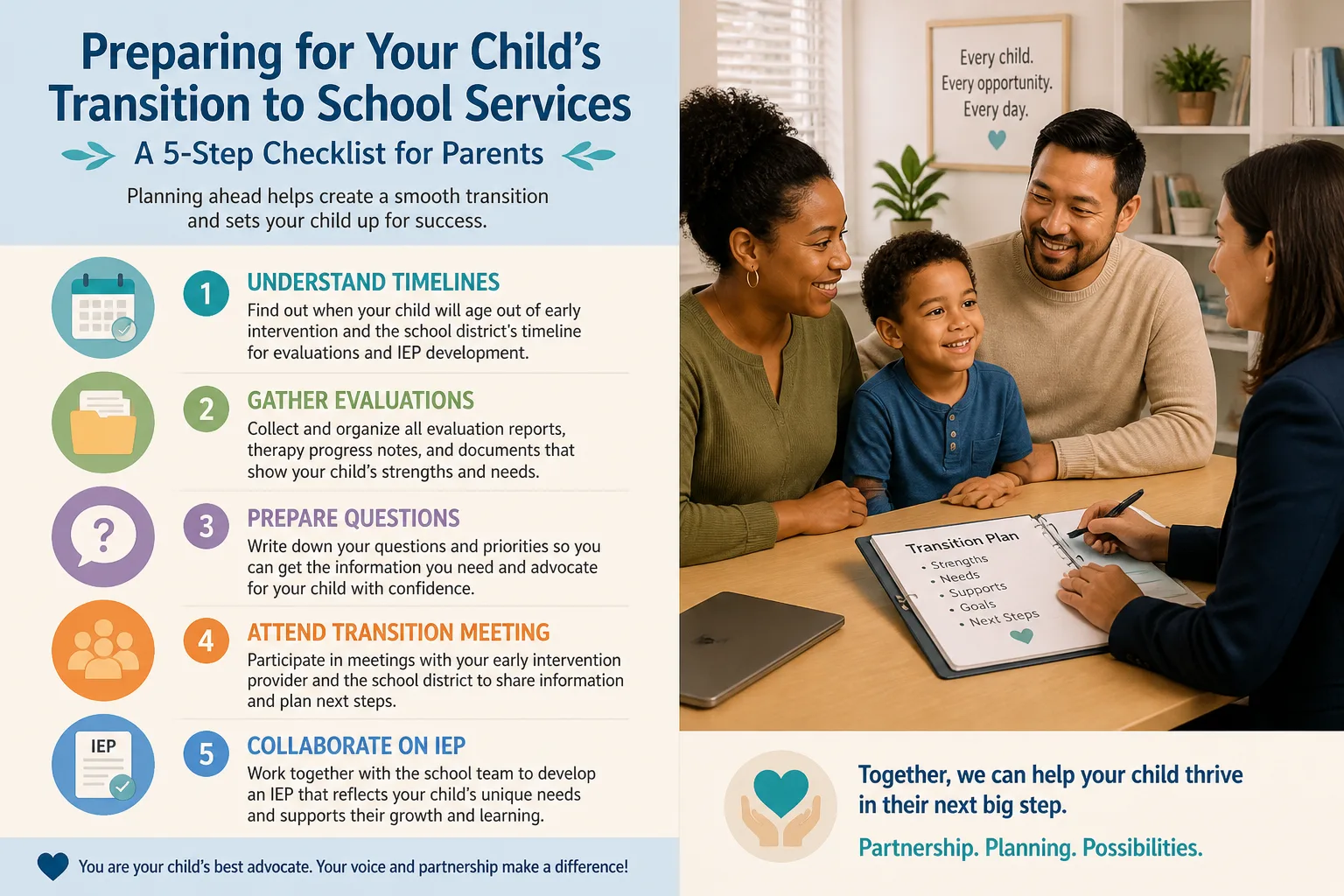
Preparation is key to effective advocacy. Here are practical steps to take:

1. Understand Your State’s Transition Timeline and Process

Each state has specific timelines for notifying families about transition and initiating evaluations. Typically, the EI program must notify you when your child turns two years and six months to start planning. Contact your local early intervention coordinator or school district to clarify timelines and required steps.

2. Gather and Organize Your Child’s Evaluations and Reports

Collect all relevant documents from EI, including developmental assessments, therapy reports, and progress notes. These will inform the school evaluation team and help avoid redundant testing. Bring copies to meetings and keep originals safe.

3. Prepare Questions to Ask the School Team

Having a list of questions helps you engage confidently during meetings. Examples include:

  • What evaluations will the school conduct, and when?
  • How does the school determine eligibility for special education services?
  • What supports and accommodations are available for my child’s communication and sensory needs?
  • How will my child’s strengths and preferences be included in the IEP?
  • Who will be my main point of contact during the transition?

4. Document Your Child’s Strengths, Needs, and Communication Methods

Write down specific examples of your child’s abilities, challenges, and how they communicate, whether through speech, AAC, gestures, or other methods. This helps the team understand your child beyond diagnostic labels and supports personalized planning.

5. Attend the Transition Meeting and Advocate Collaboratively

The transition meeting (sometimes called a “transition conference”) brings together EI providers, school staff, and your family to discuss your child’s needs and plan next steps. Approach this meeting as a partner, sharing your insights and concerns respectfully. If you disagree with any recommendations, ask for clarification or request additional evaluations. Remember, you can also seek a second opinion or bring an advocate if needed.

How to Include Your Child’s Voice and Dignity

Whenever developmentally appropriate, involve your child in the transition process. This might mean observing their preferences during visits to the school or asking them simple questions about what they enjoy or find challenging. Respect their communication style and avoid forcing speech or eye contact. Advocating for supports that honor your child’s sensory and communication needs protects their dignity and promotes comfort in the new environment.

Common Pitfalls to Avoid

  • Waiting until the last minute to start the transition process, risking service gaps.
  • Assuming school eligibility criteria are the same as EI without verification.
  • Not sharing your child’s full communication profile, leading to inappropriate supports.
  • Accepting vague or non-measurable goals in the IEP without requesting clarity.
  • Feeling pressured to agree with professionals without asking questions or requesting explanations.

When to Seek Additional Guidance

If you encounter persistent disagreements with the school, unclear procedures, or feel your child’s rights are not being honored, consider consulting a special education advocate or attorney knowledgeable about IDEA. Local parent training and information centers (PTIs) can also provide free support and resources.

Key Takeaway

Starting early, staying organized, asking informed questions, and collaborating respectfully with professionals empower you to advocate effectively for your child’s smooth transition from early intervention to school services, ensuring their unique needs and voice remain central.

What is one question or concern you have about your child’s upcoming transition to school services?

Download the images in this article

  • Advocating for Your Child’s Transition from Early Intervention to School Services: A

Tags:

autism supportearly interventionIEPparent advocacyspecial education advocacytransition from early intervention to school services
Author

Sarah Mitchell

Follow Me
Other Articles
Childhood Scurvy in Japan Linked to Selective Diets, Especially in Children with
Previous

Childhood Scurvy in Japan Linked to Selective Diets, Especially in Children with Autism Spectrum Disorder

Community Collaboration Enhances Anxiety Therapy for Autistic Youth in Real-World Settings
Next

Community Collaboration Enhances Anxiety Therapy for Autistic Youth in Real-World Settings

No Comment! Be the first one.

Leave a Reply Cancel reply

Your email address will not be published. Required fields are marked *

ADHD ASD ASD research autism autism communication autism diagnosis autism parenting autism research autism spectrum disorder autism support autistic adults autistic children child communication child development child independence communication communication skills communication support communication supports communication tools coping strategies daily living skills early intervention emotional regulation fine motor skills Functional Communication intellectual disability language development learning through play mental health mouse model neurodevelopment neurodevelopmental disorders neurodiversity neuroinflammation parent advocacy positive behavior support sensory accommodations sensory needs sensory processing sensory support sex differences visual learning set visual routine young children

  • Halliwick Aquatic Therapy Linked to Improved Quality of Life in Children with
    Halliwick Aquatic Therapy Linked to Improved Quality of Life in Children with Autism Spectrum Disorder
    A study suggests that Halliwick-based aquatic physical activity may improve quality of life in children and adolescents with autism spectrum disorder, showing benefits in psychological well-being and autonomy.
  • New Insights into Autism: Linking Brain Fluid Dynamics and Network Development to
    New Insights into Autism: Linking Brain Fluid Dynamics and Network Development to Clinical Outcomes
    New research explores how brain fluid movement and neural network development may influence autism's clinical outcomes, offering insights into its diverse trajectories.
  • Study Links Perceived Stress and Auditory Sensitivity in Autistic and Non-Autistic University
    Study Links Perceived Stress and Auditory Sensitivity in Autistic and Non-Autistic University Students
    A study finds perceived stress is linked to auditory sensitivity in autistic and non-autistic university students, with autistic students showing higher sensitivity.
  • New Study Supports Reliable Autism Intervention Measures Across Clinic and Home Settings
    New Study Supports Reliable Autism Intervention Measures Across Clinic and Home Settings
    A recent study found that brief observational tools measuring social communication and caregiver strategies in young autistic children are reliable and feasible across both clinic and home settings, supporting flexible early intervention assessments.
  • Study Highlights Social Disadvantages Impacting Health of Autistic Adults Without Intellectual Disability
    Study Highlights Social Disadvantages Impacting Health of Autistic Adults Without Intellectual Disability
    A UK study finds autistic adults without intellectual disability face social disadvantages that contribute to higher chronic illness and mortality risks, highlighting the need for systemic policy changes.
Advocating for Your Child When They Experience Bullying at School: A Practical
Advocating for Your Child When They Experience Bullying at School: A Practical Parent Guide
September 25, 2026
Advocating for Your Child's Participation in School Activities: A Practical Parent Guide
Advocating for Your Child’s Participation in School Activities: A Practical Parent Guide
September 23, 2026
Advocating for Your Child During School Evaluations: A Practical Parent Guide
September 20, 2026
Advocating for Your Child's Inclusion in School Activities: A Practical Parent Guide
Advocating for Your Child’s Inclusion in School Activities: A Practical Parent Guide
September 15, 2026
Study Reveals Sex-Specific Behavioral Changes in Mice Lacking α5-Nicotinic Acetylcholine Receptors
157 views
Preparing for Loud Events: 6 Sensory Support Steps for Children
137 views
Expressing Discomfort and Asking for Help: 6 Essential Communication Phrases for Young
Expressing Discomfort and Asking for Help: 6 Essential Communication Phrases for Young Children
131 views
Feeling Worried: 6 Steps to Help Young Children Recognize and Manage Worry
129 views
Using a Calm Voice: 5 Positive Steps for Young Children
127 views

Content on this website is created with the assistance of artificial intelligence (AI), while some portions are still reviewed and overseen by humans. All content and resources are provided completely free of charge.

Some information may be referenced or cited from reputable sources. Whenever possible, we will clearly identify the sources used within each article.

If you have any questions, feedback, or would like to contact us, please email: info@autismwords.com

Copyright 2026 — Love Beyond Words - autismwords.com. All rights reserved. Blogsy WordPress Theme

Join Us on the Journey to Understanding Autism

Subscribe to receive curated autism knowledge, lessons, and the latest news — delivered to you regularly.

We promise to send only helpful autism-related information and knowledge — no ads, no spam. You can unsubscribe anytime.

Thank you for subscribing!