
Teaching opposites is a wonderful way to build young children’s vocabulary and language comprehension. Opposites help children understand differences, compare objects and feelings, and describe the world around them. This post teaches 6 common opposite words using clear, child-friendly examples that are easy to understand and fun to talk about.
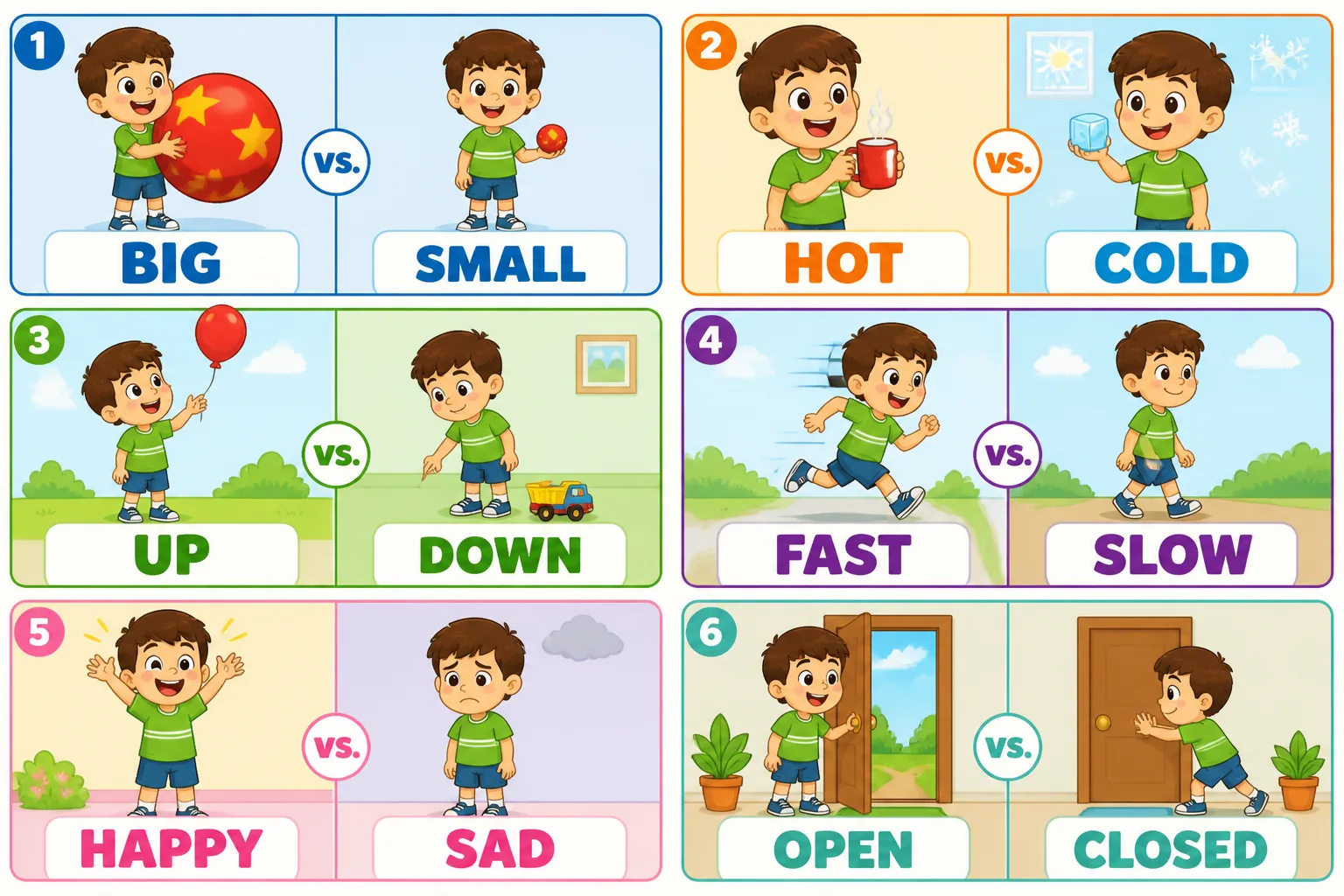
1. BIG / SMALL
Show your child two objects that are very different in size, like a big ball and a small ball. Say, “This ball is big. This ball is small.” Encourage your child to point or name the objects.
2. HOT / COLD
Use safe examples like a warm cup (not too hot) and an ice cube or cold drink. Model sentences like, “The drink is hot. The ice is cold.” Let your child explore and describe what they feel.
3. UP / DOWN
Point to things that are up high (like a balloon) and things on the ground. Say, “Look up! The balloon is up. Look down! The toy is down.” Use gestures to reinforce the concepts.
4. FAST / SLOW
Encourage your child to move fast and slow. Say, “Run fast! Walk slow.” You can also describe animals or vehicles, “The car is fast. The turtle is slow.”
5. HAPPY / SAD
Talk about feelings using faces and expressions. “You look happy! Why are you happy? Now, show me a sad face.” This helps children recognize emotions and express how they feel.
6. OPEN / CLOSED
Use doors, boxes, or books to show open and closed. Say, “The door is open. Now it is closed.” Let your child practice opening and closing objects safely.
How Parents Can Practice Opposites Naturally
Try to use opposites in everyday routines without pressuring your child to repeat. For example, during snack time, you might say, “The big apple and the small banana.” When dressing, “Your jacket is open. Let’s close it.” Use gestures and point to objects to support understanding. Praise your child’s attempts to communicate, whether by words, gestures, or pointing.
Remember, the goal is to make learning opposites fun and interactive. Repetition in natural contexts helps children absorb new words and concepts.
Parent question: Which opposite word do you think your child will enjoy learning first? Why?
Download the images in this article