
How to Ask for Help: 5 Clear Social Steps for Children
Learning how to ask for help is an important social skill for young children, including autistic children and those who need extra communication or emotional support. Asking for help allows children to get assistance when they need it, feel more confident, and connect with others in everyday situations. This article explains why asking for help matters, what might make it difficult, and practical ways children can communicate their needs respectfully and clearly.
Why This Skill Matters
Asking for help is a key skill that supports independence and social connection. When children can ask for help, they can participate more fully in activities, solve problems, and feel safer. It also helps adults and peers understand what the child needs, reducing frustration and misunderstandings. This skill builds trust and encourages positive interactions.
What May Make This Hard
Some children may find asking for help challenging due to:
- Communication difficulties: Finding the right words or using speech can be hard.
- Sensory sensitivities: Noisy or busy environments may feel overwhelming.
- Emotional factors: Fear of being ignored, misunderstood, or feeling shy.
- Social uncertainty: Not knowing how or when to ask for help appropriately.
What Parents May Notice
- The child tries to do everything alone and gets frustrated.
- The child uses gestures, pointing, or AAC instead of words.
- The child avoids asking for help even when needed.
- The child may become upset or shut down when stuck.
What the Child Can Learn
Children can learn these practical steps to ask for help:
- Recognize when help is needed: Understanding when a task is too hard or confusing.
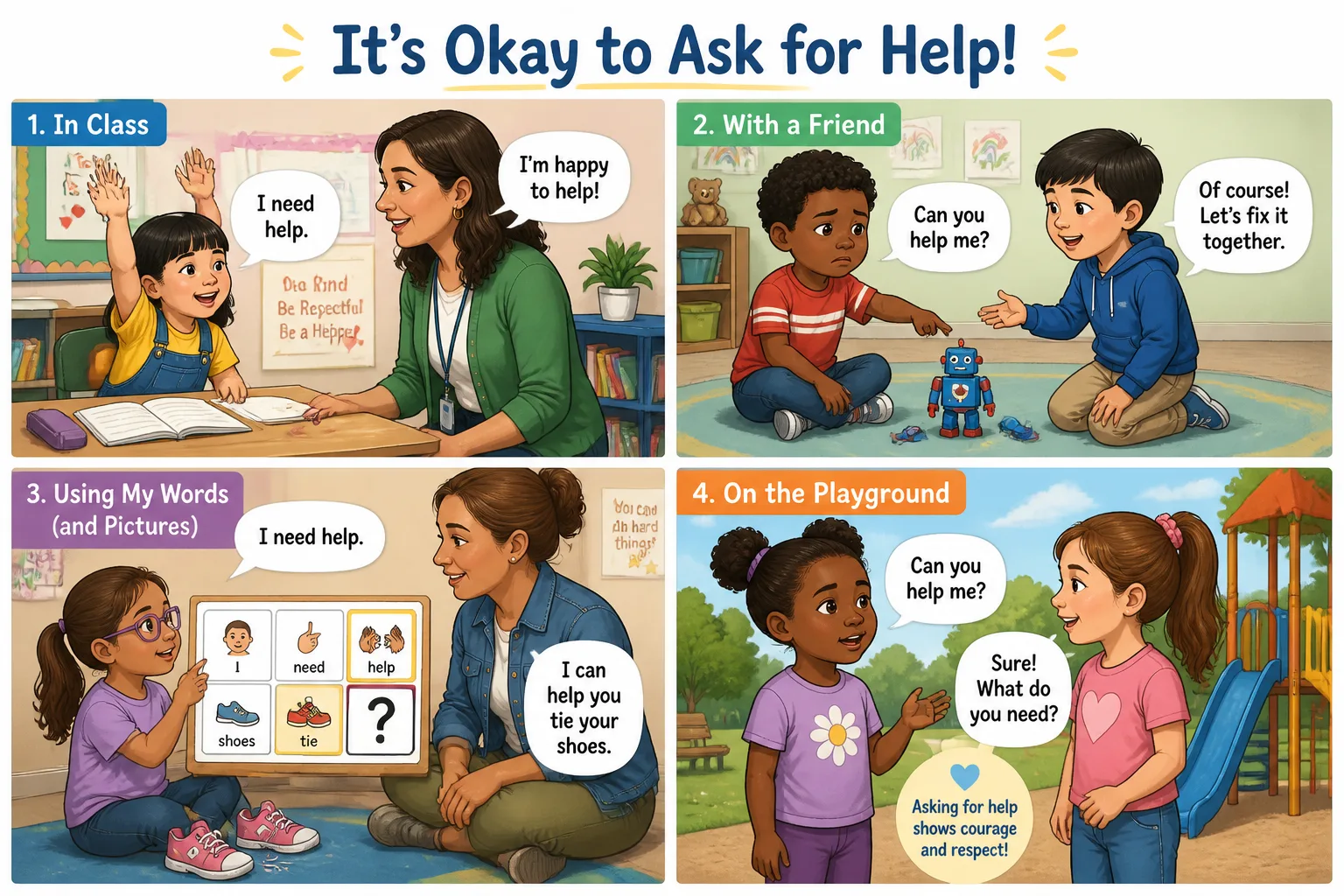
- Use words or other communication: Saying or showing “Can you help me?” or “I need help.”
- Get someone’s attention: Raising a hand, tapping gently, or pointing.
- Be patient while waiting for a response: Allowing time for the other person to understand and reply.
- Accept help or ask again if needed: Saying “Thank you” or “Can you help me again?” if the problem continues.
Helpful Words or Phrases
Children can use simple, clear phrases or signs such as:
- “Can you help me?”
- “I need help.”
- “Please help.”
- “I don’t understand.”
- “Can you show me?”
- Using AAC devices or picture cards showing help-related icons.
How Parents Can Practice
Parents and caregivers can support practice by:
- Modeling asking for help: Verbally or with gestures during daily routines.
- Role-playing: Pretend scenarios where the child asks for help and receives it.
- Using visual supports: Picture cards or communication boards showing help requests.
- Creating safe environments: Encouraging the child to ask without pressure or judgment.
- Praising meaningful communication: Focus on effort rather than perfect words.
What Adults Can Say
Supportive adult language might include:
- “I see you need help. How can I help you?”
- “Thank you for telling me you need help.”
- “It’s okay to ask for help when you need it.”
- “Can you show me what you want help with?”
- “I’m here to help whenever you’re ready.”
What to Avoid
Avoid pressuring the child to ask for help or making them feel bad for needing it. Do not force speech if the child uses AAC or gestures. Avoid ignoring or dismissing their requests. Never shame the child for asking or for needing extra time.
Real-Life Example
At the playground, Mia wanted to climb the slide ladder but felt unsure. She raised her hand and said, “Can you help me?” to her teacher. The teacher came over, helped Mia find the best way up, and praised her for asking. Mia smiled and felt proud she could ask for help when she needed it.
Key Takeaway
Teaching children how to ask for help empowers them to communicate their needs, participate more fully, and build positive relationships. Respecting their communication style and boundaries is essential for meaningful connection.
What is one way your child likes to ask for help?
Download the images in this article