Skip to content
Love Beyond Words - autismwords.com Love Beyond Words - autismwords.com Love Beyond Words - autismwords.com

Supporting children with autism through education and care

Love Beyond Words - autismwords.com Love Beyond Words - autismwords.com Love Beyond Words - autismwords.com

Supporting children with autism through education and care

  • Learning & Support
    • Communication Skills
    • Daily Living Skills
    • Emotional Regulation
    • Everyday Challenges
    • Learning Through Play
    • Parent Education & Advocacy
    • Positive Behavior Support
    • Routines & Transitions
    • Social Skills
    • Speech & Language
  • Autism News & Perspectives
  • Hero News
  • Learning & Support
    • Communication Skills
    • Daily Living Skills
    • Emotional Regulation
    • Everyday Challenges
    • Learning Through Play
    • Parent Education & Advocacy
    • Positive Behavior Support
    • Routines & Transitions
    • Social Skills
    • Speech & Language
  • Autism News & Perspectives
  • Hero News
Close

Search

  • https://www.facebook.com/
  • https://twitter.com/
  • https://t.me/
  • https://www.instagram.com/
  • https://youtube.com/
Love Beyond Words - autismwords.com Love Beyond Words - autismwords.com Love Beyond Words - autismwords.com

Supporting children with autism through education and care

Love Beyond Words - autismwords.com Love Beyond Words - autismwords.com Love Beyond Words - autismwords.com

Supporting children with autism through education and care

  • Learning & Support
    • Communication Skills
    • Daily Living Skills
    • Emotional Regulation
    • Everyday Challenges
    • Learning Through Play
    • Parent Education & Advocacy
    • Positive Behavior Support
    • Routines & Transitions
    • Social Skills
    • Speech & Language
  • Autism News & Perspectives
  • Hero News
  • Learning & Support
    • Communication Skills
    • Daily Living Skills
    • Emotional Regulation
    • Everyday Challenges
    • Learning Through Play
    • Parent Education & Advocacy
    • Positive Behavior Support
    • Routines & Transitions
    • Social Skills
    • Speech & Language
  • Autism News & Perspectives
  • Hero News
Close

Search

  • https://www.facebook.com/
  • https://twitter.com/
  • https://t.me/
  • https://www.instagram.com/
  • https://youtube.com/
Home/Learning & Support/Parent Education & Advocacy/Advocating for Behavior Support Plans at School: A Practical Guide for Parents
Advocating for Behavior Support Plans at School: A Practical Guide for Parents
Parent Education & Advocacy

Advocating for Behavior Support Plans at School: A Practical Guide for Parents

By Daniel Nguyen
September 13, 2026 3 Min Read
0

Understanding how to advocate for a behavior support plan (BSP) at school is essential for parents of autistic children and children with additional needs. A BSP is a written plan developed by educators and specialists designed to support a child’s positive behavior and address behaviors that may interfere with learning or social participation. Advocating effectively for a BSP ensures your child’s dignity, communication preferences, and sensory needs are respected while promoting a safe and supportive school environment.

What Is a Behavior Support Plan and Why Does It Matter?

A behavior support plan outlines strategies and supports tailored to your child’s unique needs to reduce challenging behaviors and teach new skills. It is based on understanding why a behavior occurs (the function) rather than simply trying to stop it. BSPs matter because they help schools respond constructively and consistently, preventing misunderstandings and disciplinary actions that can harm your child’s well-being and educational progress.

Common Situations Parents May Encounter

Parents often notice their child struggling with behaviors such as meltdowns, withdrawal, or repetitive actions that teachers find challenging to manage. Sometimes schools may suggest a BSP without fully explaining it, or parents may feel their concerns about behavior triggers are not heard. In other cases, a BSP might be proposed but lacks measurable goals or doesn’t include supports for communication or sensory needs.

Preparing to Advocate for a Behavior Support Plan

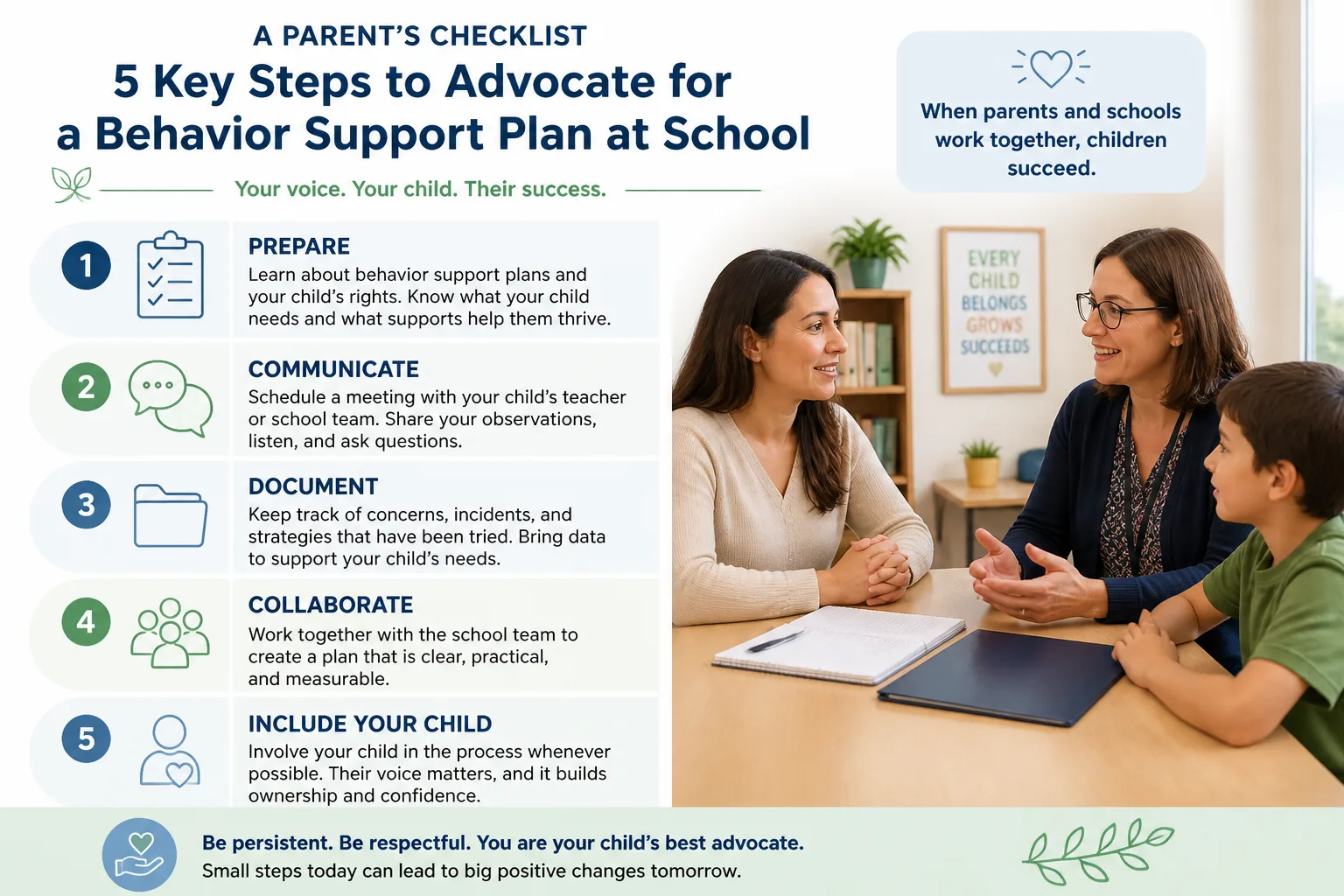
Preparation is key to effective advocacy. Here are practical steps you can take before meetings:

  • Document observations: Keep a detailed log of behaviors, including what happens before, during, and after (antecedents and consequences). Note your child’s communication attempts and sensory triggers.
  • Gather reports: Bring any evaluations, therapy notes, or previous BSPs to provide a full picture.
  • Learn your rights: Understand your child’s educational rights under IDEA or Section 504 (rules vary by location).
  • Prepare questions: Think about what you want to know or clarify, such as how the plan will respect your child’s communication style or sensory needs.

Example questions to ask:

  • “How will this plan support my child’s communication preferences, including AAC or gestures?”
  • “What sensory accommodations are included to prevent behaviors triggered by sensory overload?”
  • “How will progress be measured and shared with us?”
  • “Who will be responsible for implementing and monitoring the plan?”

Advocacy Strategies During Meetings

During meetings, clear and respectful communication helps build collaboration:

  • Use “I” statements: For example, “I have noticed that loud noises seem to upset my child, and we would like to include noise-cancelling headphones as a support.”
  • Request measurable goals: Ask for specific, observable objectives rather than vague language.
  • Emphasize your child’s strengths: Highlight what your child can do and how supports can build on these.
  • Include your child’s voice: When appropriate, involve your child in the discussion or share their preferences and feelings.
  • Clarify terminology: Don’t hesitate to ask for explanations in plain language.

Common Pitfalls to Avoid

  • Accepting plans that focus only on “stopping” behavior without teaching skills or respecting communication.
  • Agreeing to punitive measures without exploring positive supports.
  • Overlooking sensory or communication needs that may underlie behaviors.
  • Failing to document or follow up on the plan’s implementation and effectiveness.

Collaborating with Professionals

Remember that advocacy is a partnership. Share your observations and be open to professionals’ expertise while firmly representing your child’s needs. If you feel your concerns are dismissed, consider requesting a second opinion or involving a special education advocate. Keep records of all communications and meetings.

Including Your Child’s Voice and Dignity

Your child’s dignity and autonomy should be central. Support their communication choices, whether speech, AAC, sign, or gestures. Avoid approaches that require forced compliance or masking. Encourage the school to respect your child’s sensory needs and provide safe spaces when needed.

When to Seek Additional Guidance

If behavior challenges escalate or you face resistance from the school, consult with a special education advocate, therapist, or legal professional familiar with your state’s laws. Early intervention and clear documentation can prevent conflicts and ensure your child receives appropriate support.

Key Takeaway

Advocating for a behavior support plan is about ensuring your child’s unique needs, communication, and dignity are respected while promoting positive, skill-building supports. Preparation, clear communication, and collaboration with professionals empower you to secure a plan that truly benefits your child.

What are your biggest questions or concerns about behavior support plans at your child’s school?

Descarga las imágenes de este artículo

  • Advocating for Behavior Support Plans at School: A Practical Guide for Parents

Tags:

autism advocacybehavior support planbehavior support plan advocacycommunication supportsIEP behavior supportsparent advocacyschool behavior supportsensory accommodations
Author

Daniel Nguyen

Follow Me
Other Articles
Long-Term Neurodevelopmental Challenges Persist in Infants Treated for Vitamin B12 Deficiency Syndrome
Previous

Long-Term Neurodevelopmental Challenges Persist in Infants Treated for Vitamin B12 Deficiency Syndrome

Supporting Young Children Who Have Difficulty Waiting for Help: 6 Positive Steps
Next

Supporting Young Children Who Have Difficulty Waiting for Help: 6 Positive Steps for Parents

No Comment! Be the first one.

Leave a Reply Cancel reply

Your email address will not be published. Required fields are marked *

ADHD ASD ASD research autism autism communication autism diagnosis autism parenting autism research autism spectrum disorder autism support autistic adults autistic children child communication child development child independence communication communication skills communication support communication supports communication tools coping strategies daily living skills early intervention emotional regulation fine motor skills Functional Communication intellectual disability language development learning through play mental health mouse model neurodevelopment neurodevelopmental disorders neurodiversity neuroinflammation parent advocacy positive behavior support sensory accommodations sensory needs sensory processing sensory support sex differences visual learning set visual routine young children

  • Halliwick Aquatic Therapy Linked to Improved Quality of Life in Children with
    Halliwick Aquatic Therapy Linked to Improved Quality of Life in Children with Autism Spectrum Disorder
    A study suggests that Halliwick-based aquatic physical activity may improve quality of life in children and adolescents with autism spectrum disorder, showing benefits in psychological well-being and autonomy.
  • New Insights into Autism: Linking Brain Fluid Dynamics and Network Development to
    New Insights into Autism: Linking Brain Fluid Dynamics and Network Development to Clinical Outcomes
    New research explores how brain fluid movement and neural network development may influence autism's clinical outcomes, offering insights into its diverse trajectories.
  • Study Links Perceived Stress and Auditory Sensitivity in Autistic and Non-Autistic University
    Study Links Perceived Stress and Auditory Sensitivity in Autistic and Non-Autistic University Students
    A study finds perceived stress is linked to auditory sensitivity in autistic and non-autistic university students, with autistic students showing higher sensitivity.
  • New Study Supports Reliable Autism Intervention Measures Across Clinic and Home Settings
    New Study Supports Reliable Autism Intervention Measures Across Clinic and Home Settings
    A recent study found that brief observational tools measuring social communication and caregiver strategies in young autistic children are reliable and feasible across both clinic and home settings, supporting flexible early intervention assessments.
  • Study Highlights Social Disadvantages Impacting Health of Autistic Adults Without Intellectual Disability
    Study Highlights Social Disadvantages Impacting Health of Autistic Adults Without Intellectual Disability
    A UK study finds autistic adults without intellectual disability face social disadvantages that contribute to higher chronic illness and mortality risks, highlighting the need for systemic policy changes.
Advocating for Your Child When They Experience Bullying at School: A Practical
Advocating for Your Child When They Experience Bullying at School: A Practical Parent Guide
September 25, 2026
Advocating for Your Child's Participation in School Activities: A Practical Parent Guide
Advocating for Your Child’s Participation in School Activities: A Practical Parent Guide
September 23, 2026
Advocating for Your Child During School Evaluations: A Practical Parent Guide
September 20, 2026
Advocating for Your Child's Transition from Early Intervention to School Services: A
Advocating for Your Child’s Transition from Early Intervention to School Services: A Practical Parent Guide
September 18, 2026
Study Reveals Sex-Specific Behavioral Changes in Mice Lacking α5-Nicotinic Acetylcholine Receptors
156 views
Preparing for Loud Events: 6 Sensory Support Steps for Children
137 views
Expressing Discomfort and Asking for Help: 6 Essential Communication Phrases for Young
Expressing Discomfort and Asking for Help: 6 Essential Communication Phrases for Young Children
131 views
Feeling Worried: 6 Steps to Help Young Children Recognize and Manage Worry
129 views
Using a Calm Voice: 5 Positive Steps for Young Children
127 views

Content on this website is created with the assistance of artificial intelligence (AI), while some portions are still reviewed and overseen by humans. All content and resources are provided completely free of charge.

Some information may be referenced or cited from reputable sources. Whenever possible, we will clearly identify the sources used within each article.

If you have any questions, feedback, or would like to contact us, please email: info@autismwords.com

Copyright 2026 — Love Beyond Words - autismwords.com. All rights reserved. Blogsy WordPress Theme

Join Us on the Journey to Understanding Autism

Subscribe to receive curated autism knowledge, lessons, and the latest news — delivered to you regularly.

We promise to send only helpful autism-related information and knowledge — no ads, no spam. You can unsubscribe anytime.

Thank you for subscribing!