Skip to content
Love Beyond Words - autismwords.com Love Beyond Words - autismwords.com Love Beyond Words - autismwords.com

Supporting children with autism through education and care

Love Beyond Words - autismwords.com Love Beyond Words - autismwords.com Love Beyond Words - autismwords.com

Supporting children with autism through education and care

  • Learning & Support
    • Communication Skills
    • Daily Living Skills
    • Emotional Regulation
    • Everyday Challenges
    • Learning Through Play
    • Parent Education & Advocacy
    • Positive Behavior Support
    • Routines & Transitions
    • Social Skills
    • Speech & Language
  • Autism News & Perspectives
  • Hero News
  • Learning & Support
    • Communication Skills
    • Daily Living Skills
    • Emotional Regulation
    • Everyday Challenges
    • Learning Through Play
    • Parent Education & Advocacy
    • Positive Behavior Support
    • Routines & Transitions
    • Social Skills
    • Speech & Language
  • Autism News & Perspectives
  • Hero News
Close

Search

  • https://www.facebook.com/
  • https://twitter.com/
  • https://t.me/
  • https://www.instagram.com/
  • https://youtube.com/
Love Beyond Words - autismwords.com Love Beyond Words - autismwords.com Love Beyond Words - autismwords.com

Supporting children with autism through education and care

Love Beyond Words - autismwords.com Love Beyond Words - autismwords.com Love Beyond Words - autismwords.com

Supporting children with autism through education and care

  • Learning & Support
    • Communication Skills
    • Daily Living Skills
    • Emotional Regulation
    • Everyday Challenges
    • Learning Through Play
    • Parent Education & Advocacy
    • Positive Behavior Support
    • Routines & Transitions
    • Social Skills
    • Speech & Language
  • Autism News & Perspectives
  • Hero News
  • Learning & Support
    • Communication Skills
    • Daily Living Skills
    • Emotional Regulation
    • Everyday Challenges
    • Learning Through Play
    • Parent Education & Advocacy
    • Positive Behavior Support
    • Routines & Transitions
    • Social Skills
    • Speech & Language
  • Autism News & Perspectives
  • Hero News
Close

Search

  • https://www.facebook.com/
  • https://twitter.com/
  • https://t.me/
  • https://www.instagram.com/
  • https://youtube.com/
Home/Learning & Support/Parent Education & Advocacy/Preparing Your Autistic Child for a New School Year: Practical Parent Advocacy Steps
Preparing Your Autistic Child for a New School Year: Practical Parent Advocacy
Parent Education & Advocacy

Preparing Your Autistic Child for a New School Year: Practical Parent Advocacy Steps

By Jennifer Bui
September 6, 2026 4 Min Read
0

Preparing your autistic child for a new school year or a change in classroom placement is a critical time that can influence their comfort, learning, and overall success. This process involves more than just buying school supplies; it requires thoughtful preparation, clear communication, and respectful advocacy to ensure your child’s unique needs are understood and met. This article offers practical strategies for parents to navigate this transition effectively, emphasizing collaboration with school professionals while centering your child’s dignity, communication preferences, sensory needs, and autonomy.

Why Preparing for a New School Year Matters

Transitions can be especially challenging for autistic children due to changes in routine, environment, and social expectations. Without proper support, these changes may lead to increased anxiety, behavioral challenges, or withdrawal. Thoughtful preparation helps reduce uncertainty, builds predictability, and empowers your child to engage meaningfully in their new setting. Advocating early and clearly with school staff sets the stage for a supportive, inclusive educational experience.

Common Situations Parents May Encounter

  • Your child is moving to a new grade or classroom with different teachers and peers.
  • There is a change in school building or district.
  • New support staff or therapists will be involved in your child’s education.
  • The school is implementing new accommodations or services.
  • Your child expresses anxiety or resistance about the upcoming change.

Steps to Prepare for the Transition

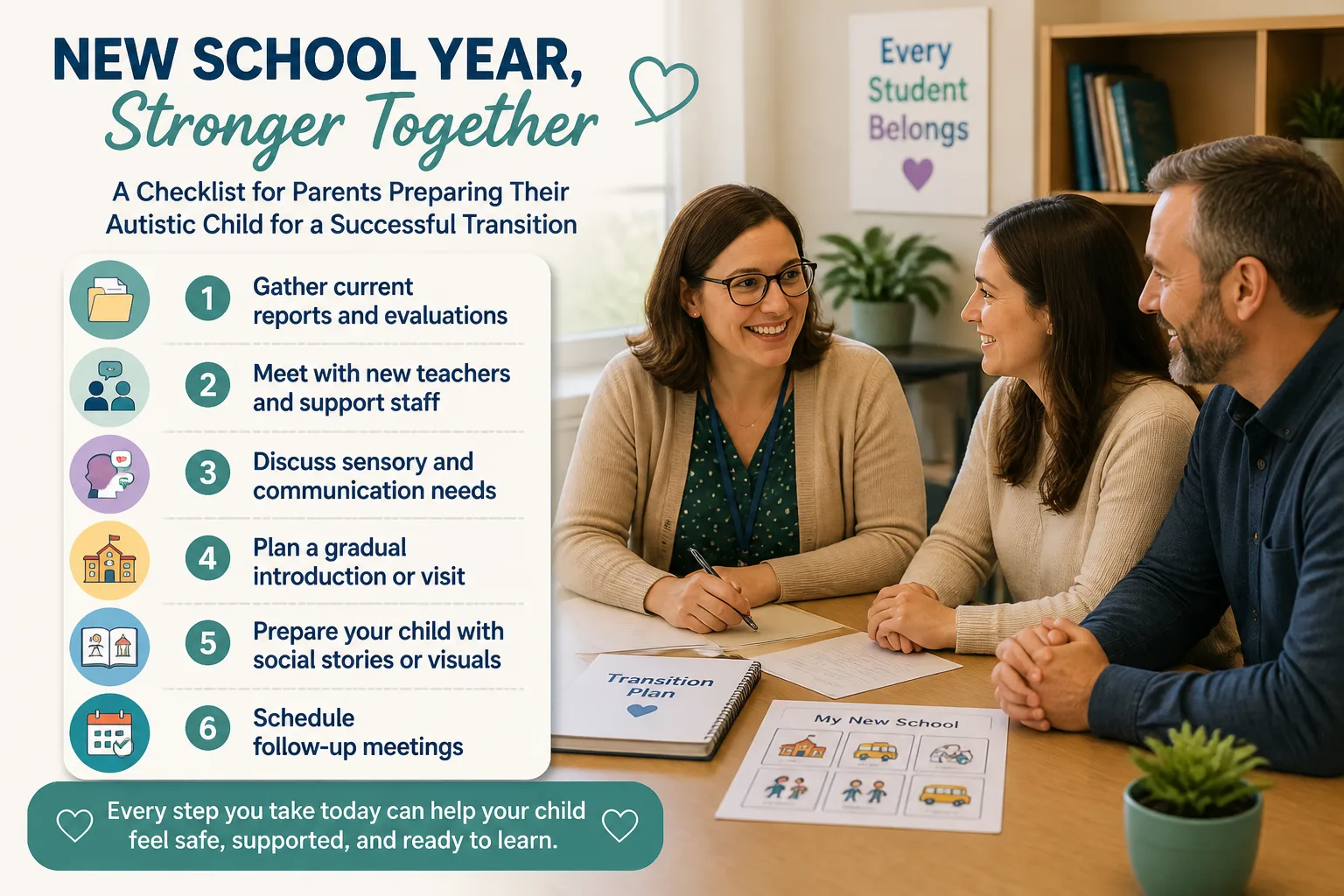
1. Gather and Review Current Reports and Evaluations

Collect recent assessments, IEPs, 504 plans, therapy reports, and any relevant documentation. Review these to understand your child’s current strengths, needs, and goals. Bringing these documents to meetings helps ensure all team members have accurate information and can plan accordingly.

2. Schedule a Meeting with New Teachers and Support Staff

Request a meeting before the school year starts to introduce your child’s profile. Use this opportunity to share what works well, what challenges exist, and specific accommodations or strategies that support your child’s learning and well-being.

Example question: “Can we discuss how my child’s communication preferences and sensory needs can be supported in the new classroom setting?”

3. Discuss Sensory and Communication Needs Explicitly

Ensure the team understands your child’s sensory sensitivities and communication methods, whether speech, AAC, gestures, or visuals. Advocate for accommodations like quiet spaces, sensory breaks, or visual schedules if helpful.

4. Plan a Gradual Introduction or School Visit

If possible, arrange for your child to visit the new classroom or meet the teacher before the first day. This helps build familiarity and reduces anxiety. Some schools offer orientation days or buddy systems to ease transitions.

5. Prepare Your Child Using Social Stories or Visual Supports

Create or obtain social stories that explain what to expect in the new school year. Visual schedules or picture books about the school environment can help your child anticipate changes and feel more in control.

6. Schedule Follow-Up Meetings Early in the School Year

Plan to meet with teachers and support staff within the first few weeks to discuss how the transition is going and adjust supports as needed. Regular communication ensures your child’s needs continue to be met.

Advocacy Strategies and Helpful Wording

  • Use clear, respectful language focusing on your child’s strengths and needs. For example: “My child benefits from visual schedules to reduce anxiety around transitions.”
  • Request measurable goals related to transition success, such as increased participation or reduced distress during classroom changes.
  • Document all communications and meetings. Keeping records helps track progress and supports future advocacy.
  • Encourage professionals to explain accommodations in plain language and ask for clarification when needed.
  • Include your child’s preferences and voice as much as possible, respecting their autonomy and communication style.

Common Pitfalls to Avoid

  • Waiting until the school year starts to address concerns or request meetings.
  • Assuming the new team knows your child’s needs without sharing detailed information.
  • Overlooking sensory or communication accommodations that are critical for your child’s comfort and participation.
  • Forcing your child to mask or comply with expectations that cause distress.
  • Neglecting to follow up and adjust supports as the school year progresses.

Collaborating Effectively with Professionals

Approach meetings as a partnership where everyone shares the goal of supporting your child’s success. Listen to staff insights and share your observations. If disagreements arise, ask for explanations and consider requesting additional evaluations or a second opinion when necessary.

For more guidance on preparing for school meetings, see Preparing for a School Meeting About Classroom Support: 6 Practical Parent Steps.

Including Your Child’s Voice

Whenever developmentally appropriate, involve your child in discussions about their needs and preferences. Use their preferred communication methods and respect their choices. This inclusion promotes self-advocacy and dignity.

When to Seek Additional Guidance

If you encounter persistent barriers, unclear communication, or feel your child’s rights are not being respected, consider consulting an educational advocate, special education attorney, or local parent support organizations. Remember, laws and policies vary by location, so check local resources for specific guidance.

Key Takeaway

Proactive, respectful preparation and advocacy before a new school year or classroom transition can greatly ease your autistic child’s adjustment, ensuring their communication, sensory, and participation needs are honored. Early collaboration with school staff and including your child’s voice are essential steps toward a successful, supportive educational experience.

What strategies have you found helpful when preparing your child for a school transition?

Download the images in this article

  • Preparing Your Autistic Child for a New School Year: Practical Parent Advocacy

Tags:

autism supportcommunication needsIEP preparationparent advocacypreparing autistic child for new school yearschool transitionsensory accommodations
Author

Jennifer Bui

Follow Me
Other Articles
Study Explores Links Between Executive Function, Attention, and Social Challenges in Children
Previous

Study Explores Links Between Executive Function, Attention, and Social Challenges in Children with NF1 and Autism

Guanfacine Extended-Release Shows Symptom and Functioning Improvements in Diverse ADHD Youth
Next

Guanfacine Extended-Release Shows Symptom and Functioning Improvements in Diverse ADHD Youth

No Comment! Be the first one.

Leave a Reply Cancel reply

Your email address will not be published. Required fields are marked *

ADHD ASD ASD research autism autism communication autism diagnosis autism parenting autism research autism spectrum disorder autism support autistic adults autistic children child communication child development child independence communication communication skills communication support communication supports communication tools coping strategies daily living skills early intervention emotional regulation fine motor skills Functional Communication intellectual disability language development learning through play mental health mouse model neurodevelopment neurodevelopmental disorders neurodiversity neuroinflammation parent advocacy positive behavior support sensory accommodations sensory needs sensory processing sensory support sex differences visual learning set visual routine young children

  • Halliwick Aquatic Therapy Linked to Improved Quality of Life in Children with
    Halliwick Aquatic Therapy Linked to Improved Quality of Life in Children with Autism Spectrum Disorder
    A study suggests that Halliwick-based aquatic physical activity may improve quality of life in children and adolescents with autism spectrum disorder, showing benefits in psychological well-being and autonomy.
  • New Insights into Autism: Linking Brain Fluid Dynamics and Network Development to
    New Insights into Autism: Linking Brain Fluid Dynamics and Network Development to Clinical Outcomes
    New research explores how brain fluid movement and neural network development may influence autism's clinical outcomes, offering insights into its diverse trajectories.
  • Study Links Perceived Stress and Auditory Sensitivity in Autistic and Non-Autistic University
    Study Links Perceived Stress and Auditory Sensitivity in Autistic and Non-Autistic University Students
    A study finds perceived stress is linked to auditory sensitivity in autistic and non-autistic university students, with autistic students showing higher sensitivity.
  • New Study Supports Reliable Autism Intervention Measures Across Clinic and Home Settings
    New Study Supports Reliable Autism Intervention Measures Across Clinic and Home Settings
    A recent study found that brief observational tools measuring social communication and caregiver strategies in young autistic children are reliable and feasible across both clinic and home settings, supporting flexible early intervention assessments.
  • Study Highlights Social Disadvantages Impacting Health of Autistic Adults Without Intellectual Disability
    Study Highlights Social Disadvantages Impacting Health of Autistic Adults Without Intellectual Disability
    A UK study finds autistic adults without intellectual disability face social disadvantages that contribute to higher chronic illness and mortality risks, highlighting the need for systemic policy changes.
Advocating for Your Child When They Experience Bullying at School: A Practical
Advocating for Your Child When They Experience Bullying at School: A Practical Parent Guide
September 25, 2026
Advocating for Your Child's Participation in School Activities: A Practical Parent Guide
Advocating for Your Child’s Participation in School Activities: A Practical Parent Guide
September 23, 2026
Advocating for Your Child During School Evaluations: A Practical Parent Guide
September 20, 2026
Advocating for Your Child's Transition from Early Intervention to School Services: A
Advocating for Your Child’s Transition from Early Intervention to School Services: A Practical Parent Guide
September 18, 2026
Study Reveals Sex-Specific Behavioral Changes in Mice Lacking α5-Nicotinic Acetylcholine Receptors
156 views
Preparing for Loud Events: 6 Sensory Support Steps for Children
137 views
Expressing Discomfort and Asking for Help: 6 Essential Communication Phrases for Young
Expressing Discomfort and Asking for Help: 6 Essential Communication Phrases for Young Children
131 views
Feeling Worried: 6 Steps to Help Young Children Recognize and Manage Worry
129 views
Using a Calm Voice: 5 Positive Steps for Young Children
127 views

Content on this website is created with the assistance of artificial intelligence (AI), while some portions are still reviewed and overseen by humans. All content and resources are provided completely free of charge.

Some information may be referenced or cited from reputable sources. Whenever possible, we will clearly identify the sources used within each article.

If you have any questions, feedback, or would like to contact us, please email: info@autismwords.com

Copyright 2026 — Love Beyond Words - autismwords.com. All rights reserved. Blogsy WordPress Theme

Join Us on the Journey to Understanding Autism

Subscribe to receive curated autism knowledge, lessons, and the latest news — delivered to you regularly.

We promise to send only helpful autism-related information and knowledge — no ads, no spam. You can unsubscribe anytime.

Thank you for subscribing!