
Teaching WH questions is a key step in helping young children develop their language skills. WH questions like who, what, where, when, why, and how help children understand and express information about people, objects, places, time, reasons, and methods. This article presents 6 simple, child-friendly examples to teach these questions visually and verbally.
Why Teach WH Questions?
WH questions support children in learning to ask and answer questions, which improves their comprehension, conversation skills, and ability to participate in social interactions. They are essential for building vocabulary, sentence skills, and understanding everyday experiences.
6 Visual Examples of WH Questions
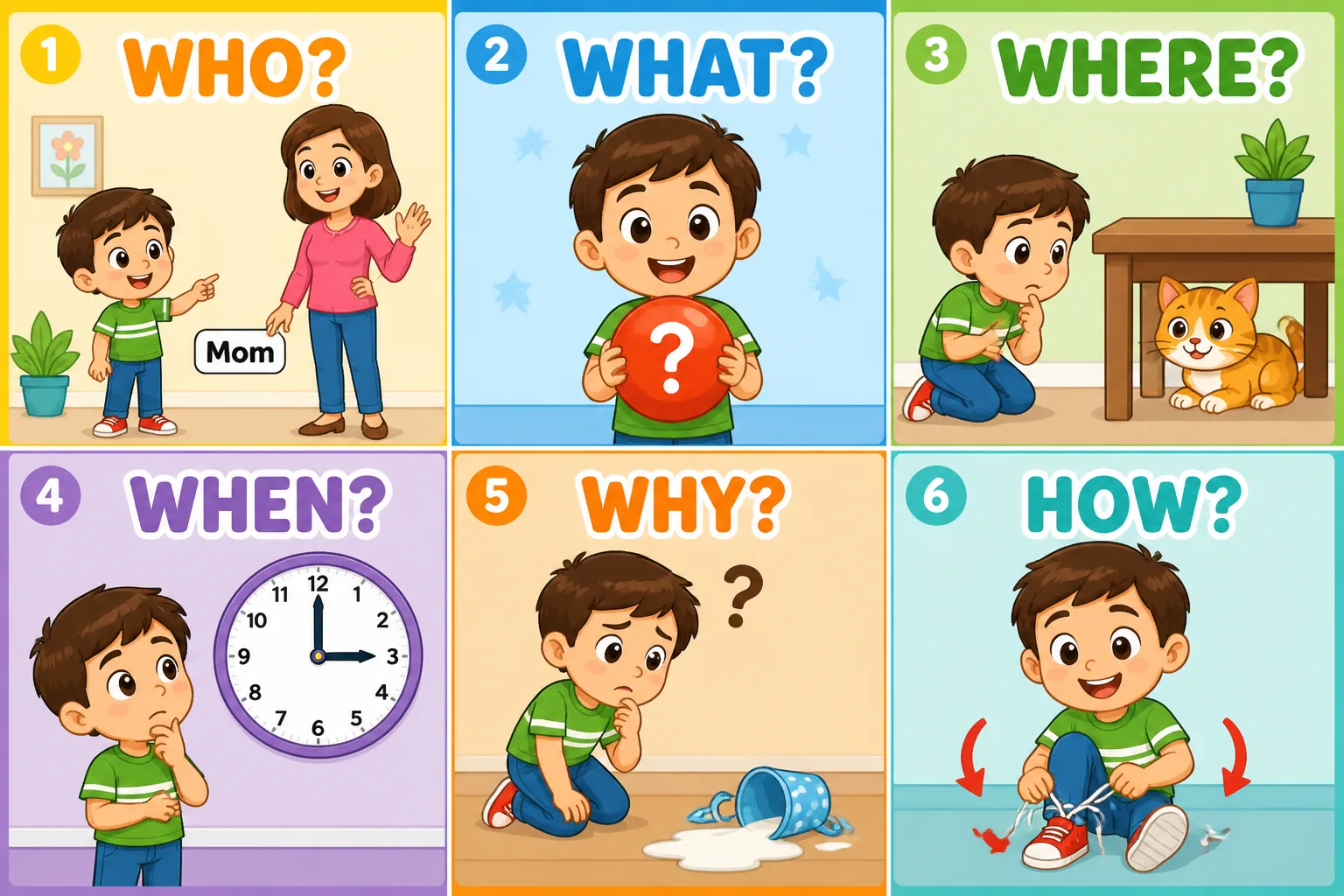
1. WHO? (People)
Show a child pointing to a familiar person, such as “Mom” or “Teacher.” This helps children learn to identify and name people.
2. WHAT? (Objects or Actions)
Present an object like a ball or a toy and ask “What is this?” This encourages naming and recognizing objects.
3. WHERE? (Location)
Use a scene showing an object or person in a place, for example, a cat under a table, to teach location words.
4. WHEN? (Time)
Introduce simple time concepts with a clock showing a specific time or daily routines like “morning” or “bedtime.”
5. WHY? (Reason)
Show a cause and effect, such as a spilled cup, and ask “Why did this happen?” to encourage thinking about reasons.
6. HOW? (Method or Process)
Demonstrate a process like tying shoelaces or washing hands, asking “How do you do this?” to teach methods.
How Parents Can Practice WH Questions Naturally
- Name the question word clearly and model it in simple phrases.
- Use everyday situations to ask these questions without pressuring the child to answer.
- Accept all responses including pointing, gestures, sounds, AAC, or words.
- Expand on the child’s responses by adding 1–2 words to model longer sentences.
- Repeat questions and answers naturally during daily routines.
For example, if your child points to a ball, you can say, “Yes, that is a ball! What is it? Ball!” If they look at a clock, say, “When is it? It is 3 o’clock. Time to play!”
Using WH questions in daily life helps children understand and use these important language tools in a fun and meaningful way.
For more ideas on supporting your child’s language development, check out our article on managing crowded spaces with sensory support and teaching common household items.
Try This at Home
Next time you play or read together, try asking one of these WH questions. Watch how your child responds and join in with simple answers or gestures. Remember, the goal is to have fun and communicate, not perfect speech.
What is your child’s favorite WH question to answer?
Download the images in this article