Skip to content
Love Beyond Words - autismwords.com Love Beyond Words - autismwords.com Love Beyond Words - autismwords.com

Supporting children with autism through education and care

Love Beyond Words - autismwords.com Love Beyond Words - autismwords.com Love Beyond Words - autismwords.com

Supporting children with autism through education and care

  • Learning & Support
    • Communication Skills
    • Daily Living Skills
    • Emotional Regulation
    • Everyday Challenges
    • Learning Through Play
    • Parent Education & Advocacy
    • Positive Behavior Support
    • Routines & Transitions
    • Social Skills
    • Speech & Language
  • Autism News & Perspectives
  • Learning & Support
    • Communication Skills
    • Daily Living Skills
    • Emotional Regulation
    • Everyday Challenges
    • Learning Through Play
    • Parent Education & Advocacy
    • Positive Behavior Support
    • Routines & Transitions
    • Social Skills
    • Speech & Language
  • Autism News & Perspectives
Close

Search

  • https://www.facebook.com/
  • https://twitter.com/
  • https://t.me/
  • https://www.instagram.com/
  • https://youtube.com/
Love Beyond Words - autismwords.com Love Beyond Words - autismwords.com Love Beyond Words - autismwords.com

Supporting children with autism through education and care

Love Beyond Words - autismwords.com Love Beyond Words - autismwords.com Love Beyond Words - autismwords.com

Supporting children with autism through education and care

  • Learning & Support
    • Communication Skills
    • Daily Living Skills
    • Emotional Regulation
    • Everyday Challenges
    • Learning Through Play
    • Parent Education & Advocacy
    • Positive Behavior Support
    • Routines & Transitions
    • Social Skills
    • Speech & Language
  • Autism News & Perspectives
  • Learning & Support
    • Communication Skills
    • Daily Living Skills
    • Emotional Regulation
    • Everyday Challenges
    • Learning Through Play
    • Parent Education & Advocacy
    • Positive Behavior Support
    • Routines & Transitions
    • Social Skills
    • Speech & Language
  • Autism News & Perspectives
Close

Search

  • https://www.facebook.com/
  • https://twitter.com/
  • https://t.me/
  • https://www.instagram.com/
  • https://youtube.com/
Home/Autism News & Perspectives/Astrocytes in the Hippocampus Influence Inhibitory Circuit Development and Behavior in Fragile X Syndrome Mouse Model
Astrocytes in the Hippocampus Influence Inhibitory Circuit Development and Behavior in Fragile
Autism News & Perspectives

Astrocytes in the Hippocampus Influence Inhibitory Circuit Development and Behavior in Fragile X Syndrome Mouse Model

August 24, 2026 2 Min Read
0

New Insights into Fragile X Syndrome and Astrocyte Function

Fragile X Syndrome (FXS), a common inherited cause of autism spectrum traits and intellectual disability, arises from the silencing of the Fmr1 gene. While previous research has largely focused on neurons, recent findings highlight a significant role for astrocytes—star-shaped glial cells—in the development of inhibitory brain circuits affected in FXS.

Study Focus and Methods

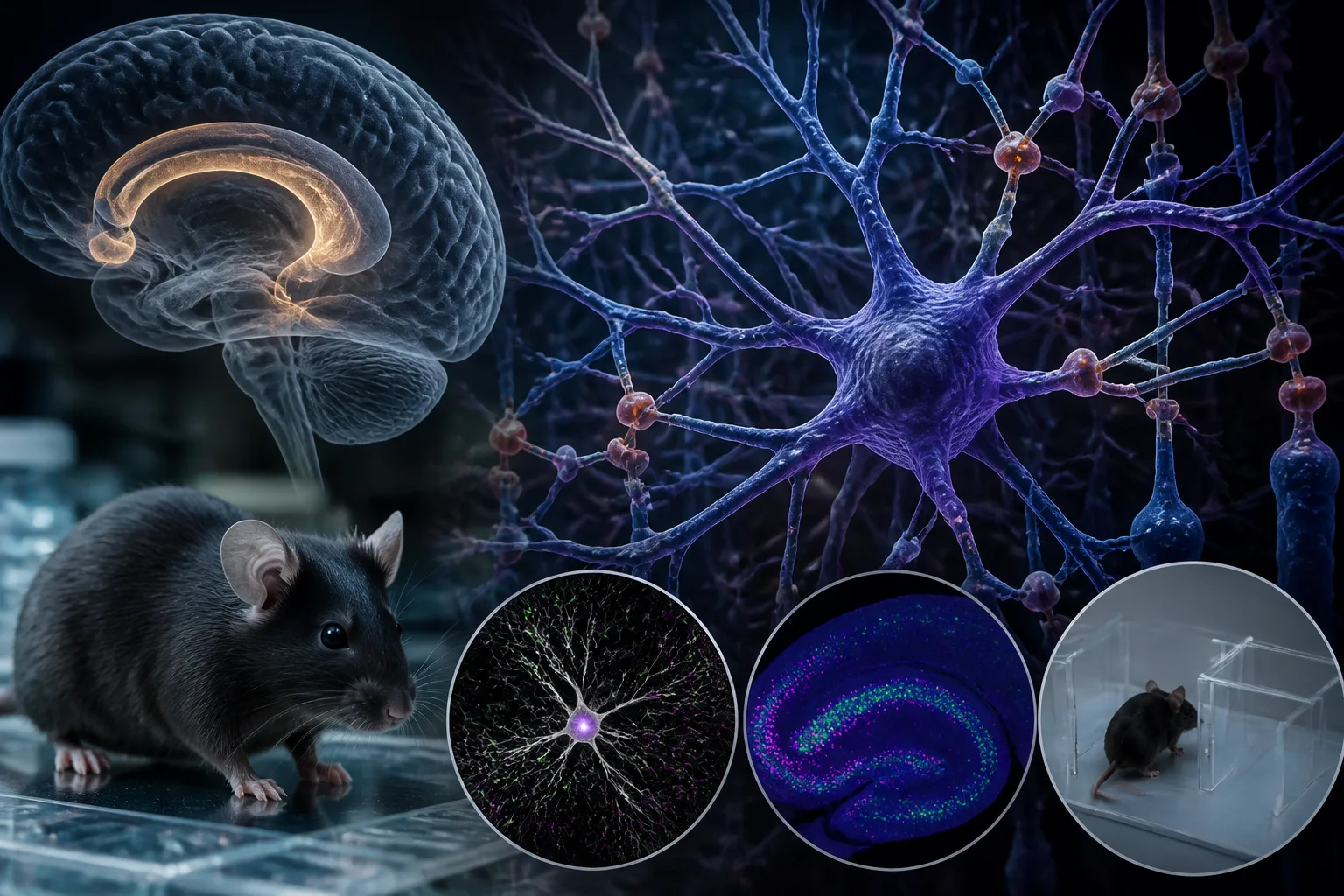
A study published in Journal of Neurochemistry investigated how astrocyte-specific deletion of the Fmr1 gene affects inhibitory signaling in the hippocampus, a brain region critical for spatial learning and social behaviors often impaired in FXS. Using slice electrophysiology in a mouse model with conditional knockout (cKO) of Fmr1 in astrocytes, researchers examined changes in inhibitory synapses and receptor expression in the CA1 hippocampal area.

Key Findings on Inhibitory Synapses and GABA Signaling

The study found that although the density of perisomatic GABAergic synapses and expression of synaptic GABAA receptor subunits were reduced in cKO mice, the amplitude of spontaneous inhibitory postsynaptic currents (sIPSCs) in pyramidal neurons was paradoxically increased. This suggests enhanced phasic inhibition despite fewer synapses.

In contrast, tonic inhibition and extrasynaptic GABAA receptor expression, which were impaired in global Fmr1 knockout mice, remained unaffected in astrocyte-specific cKO mice. This distinction points to a unique astrocyte-related mechanism influencing phasic but not tonic inhibition in the hippocampus.

Role of GABA Transport and Parvalbumin-Expressing Cells

The researchers propose that abnormal GABA transport by astrocytes lacking Fmr1 leads to elevated extracellular GABA levels, enhancing sIPSC amplitude. This altered GABA environment may impact the function of parvalbumin (PV)-expressing interneurons, which are crucial for inhibitory control.

Importantly, acute pharmacological inhibition of GABA transport in astrocytes increased PV expression and improved both spatial memory and social behaviors in the cKO mice, suggesting potential therapeutic avenues.

Implications for Understanding FXS and Potential Treatments

This study highlights astrocytes as active contributors to the development and regulation of hippocampal inhibitory circuits in Fragile X Syndrome, particularly through their role in GABA transport. These findings broaden the understanding of FXS pathophysiology beyond neurons alone and may inform strategies targeting astrocyte function to alleviate cognitive and social deficits.

Considerations and Future Directions

While these results are promising, they derive from a mouse model with selective gene deletion in astrocytes, and further research is needed to translate these findings to human FXS. The complex interplay between neurons and glial cells in inhibitory signaling warrants additional investigation to fully elucidate mechanisms and therapeutic targets.

For more detailed information, see the original study published in the Journal of Neurochemistry: source article.

Download the images in this article

  • Astrocytes in the Hippocampus Influence Inhibitory Circuit Development and Behavior in Fragile

Tags:

astrocytesFragile X SyndromeGABAergic inhibitionhippocampusmouse modelneurodevelopmentparvalbuminsocial behavior
Other Articles
Managing Crowded Spaces: 6 Sensory Support Steps for Children
Previous

Managing Crowded Spaces: 6 Sensory Support Steps for Children

When I'm Disappointed: 6 Steps to Recognize and Manage Disappointment in Young
Next

When I’m Disappointed: 6 Steps to Recognize and Manage Disappointment in Young Children

No Comment! Be the first one.

Leave a Reply Cancel reply

Your email address will not be published. Required fields are marked *

AAC asking for a break asking for help autism education autism parenting autism research Autism Science Foundation autism spectrum disorder autism support child development child independence children's feelings child transitions communication communication phrases communication skills coping strategies daily living skills early childhood development emotional regulation everyday challenges fine motor skills Functional Communication Gross Motor Skills IEP support language development learning through play parent advocacy parenting tips parent preparation positive behavior support predictable routines problem solving replacement skills school accommodations school support self-advocacy sensory breaks sensory support speech and language visual learning visual learning set visual routine visual supports young children

  • Teaching WH Questions: 6 Simple Examples for Young Children
    Teaching WH Questions: 6 Simple Examples for Young Children
    Learn how to teach young children important WH questions like who, what, where, when, why, and how with 6 simple visual examples and practical tips for parents.
  • Advancing Sleep Care in Children with Neurodevelopmental Disorders Through Phenotype-Focused Approaches
    Advancing Sleep Care in Children with Neurodevelopmental Disorders Through Phenotype-Focused Approaches
    Sleep disturbances are common in children with neurodevelopmental disorders, but diagnosis alone offers limited treatment guidance. A phenotype-focused approach may improve care.
  • Study Reveals Varied Preferences for Autism Terminology Among Autistic Individuals and Parents
    Study Reveals Varied Preferences for Autism Terminology Among Autistic Individuals and Parents in the U.S.
    A U.S. study of over 5,000 participants reveals diverse preferences for autism-related terminology, highlighting the importance of respectful, individualized language use.
  • Virtual Caregiver-Led Autism Intervention Adapted for Spanish-Speaking Families Shows Promise
    Virtual Caregiver-Led Autism Intervention Adapted for Spanish-Speaking Families Shows Promise
    A newly adapted virtual caregiver-led intervention shows potential in supporting Spanish-speaking families of children with autism by incorporating cultural and linguistic considerations.
  • Handling Disagreement: 6 Clear Steps to Support Your Child's Social Skills
    Handling Disagreement: 6 Clear Steps to Support Your Child’s Social Skills
    Teach your child 6 clear steps to handle disagreement calmly and respectfully: notice the problem, pause, say what happened, ask for space or help, choose a solution, and return when ready.
Advancing Sleep Care in Children with Neurodevelopmental Disorders Through Phenotype-Focused Approaches
August 25, 2026
Study Reveals Varied Preferences for Autism Terminology Among Autistic Individuals and Parents
Study Reveals Varied Preferences for Autism Terminology Among Autistic Individuals and Parents in the U.S.
August 25, 2026
Virtual Caregiver-Led Autism Intervention Adapted for Spanish-Speaking Families Shows Promise
August 25, 2026
Pediatric Primary Care Network Integrates Autism Spectrum Disorder Evaluation and Support Services
August 25, 2026
Preparing for Loud Events: 6 Sensory Support Steps for Children
47 views
Expressing Discomfort and Asking for Help: 6 Essential Communication Phrases for Young
Expressing Discomfort and Asking for Help: 6 Essential Communication Phrases for Young Children
47 views
Preparing for an IEP Meeting: 6 Essential Parent Steps for Success
37 views
Using a Calm Voice: 5 Positive Steps for Young Children
34 views
Color Sorting Treasure Hunt: A Fun Learning Through Play Activity
34 views

Content on this website is created with the assistance of artificial intelligence (AI), while some portions are still reviewed and overseen by humans. All content and resources are provided completely free of charge.

Some information may be referenced or cited from reputable sources. Whenever possible, we will clearly identify the sources used within each article.

If you have any questions, feedback, or would like to contact us, please email: info@autismwords.com

Copyright 2026 — Love Beyond Words - autismwords.com. All rights reserved. Blogsy WordPress Theme

Join Us on the Journey to Understanding Autism

Subscribe to receive curated autism knowledge, lessons, and the latest news — delivered to you regularly.

We promise to send only helpful autism-related information and knowledge — no ads, no spam. You can unsubscribe anytime.

Thank you for subscribing!