Systematic Review Highlights Advances and Challenges in Affective Computing for Child-Robot Interaction

Overview of Affective Computing in Child-Robot Interaction
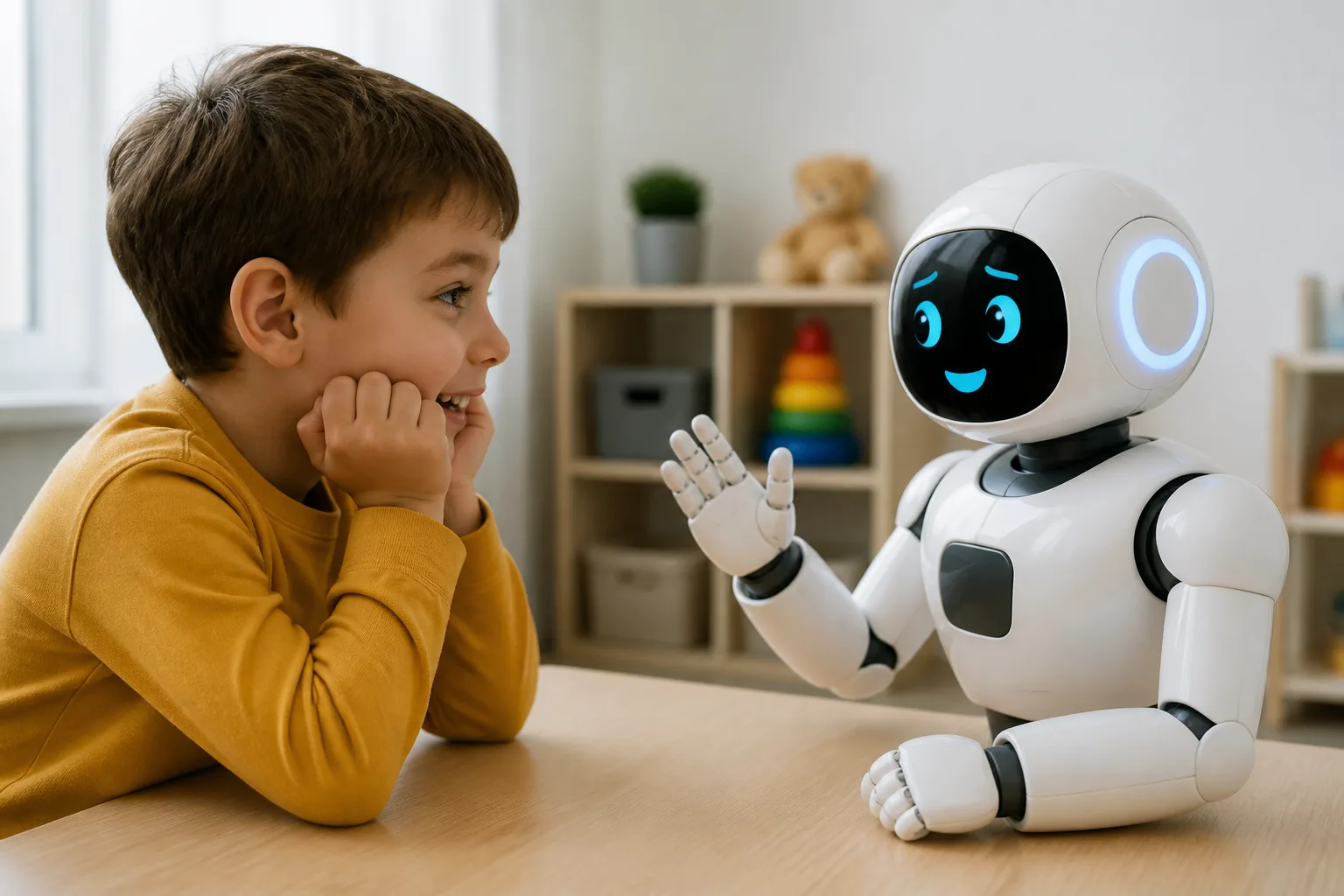
A recent systematic review has examined the growing role of affective computing within child-robot interaction (CRI), especially in social robotics applications such as emotion recognition, engagement monitoring, and interventions for autism spectrum disorder (ASD). The review analyzed 105 studies to understand how robots sense, interpret, express, and evaluate affective states during interactions with children.
Key Findings from the Review
The research synthesis revealed a strong focus on ASD-related scenarios, where robots are used to support social and emotional development. Most studies relied heavily on visual and behavioral data, including facial emotion recognition and analysis of body movements, to assess children’s affect and engagement levels.
However, the review also identified several important limitations. Camera-based sensing dominated the field, with comparatively little use of physiological sensors or other complementary modalities that could provide a richer understanding of emotional states. Additionally, many studies lacked clarity on how the robot’s role and interaction strategies aligned with affective goals.
Reporting on how robots express emotions and the control mechanisms guiding these expressions was often insufficient. The review also noted a general scarcity of attention to explainability—how and why robots interpret emotions as they do—alongside limited consideration of data governance and the long-term ethical implications of affective CRI.
Proposed Taxonomy for Affective CRI
To address fragmentation in the field, the authors proposed an integrative taxonomy encompassing six interconnected dimensions:
- Interaction context
- Sensing modalities and observed affective features
- Affective constructs and representation models
- Computational and control mechanisms
- Robot affective expression
- Evaluation and adaptation strategies
This framework consolidates existing classifications into a child-centered model of affective interaction, emphasizing the complexity and multidimensionality of emotional exchanges between children and robots.
Implications for Families and Future Research
For families and practitioners, these findings suggest that while affective CRI holds promise—particularly for children with ASD—current technologies often rely on limited sensing approaches and lack transparent, explainable emotional responses. Future developments should aim for multimodal, embodied, and developmentally appropriate robot interactions that are ethically grounded and considerate of children’s diverse needs.
Limitations and Cautions
It is important to note that the review highlights ongoing challenges rather than definitive solutions. The predominance of camera-based emotion recognition may not capture the full spectrum of children’s affective states, and ethical considerations around data use and long-term impacts require further attention.
Overall, affective computing in child-robot interaction is an evolving field that calls for interdisciplinary collaboration to enhance robot responsiveness, transparency, and ethical standards.
For more detailed information, see the original systematic review at PubMed.
Download the images in this article