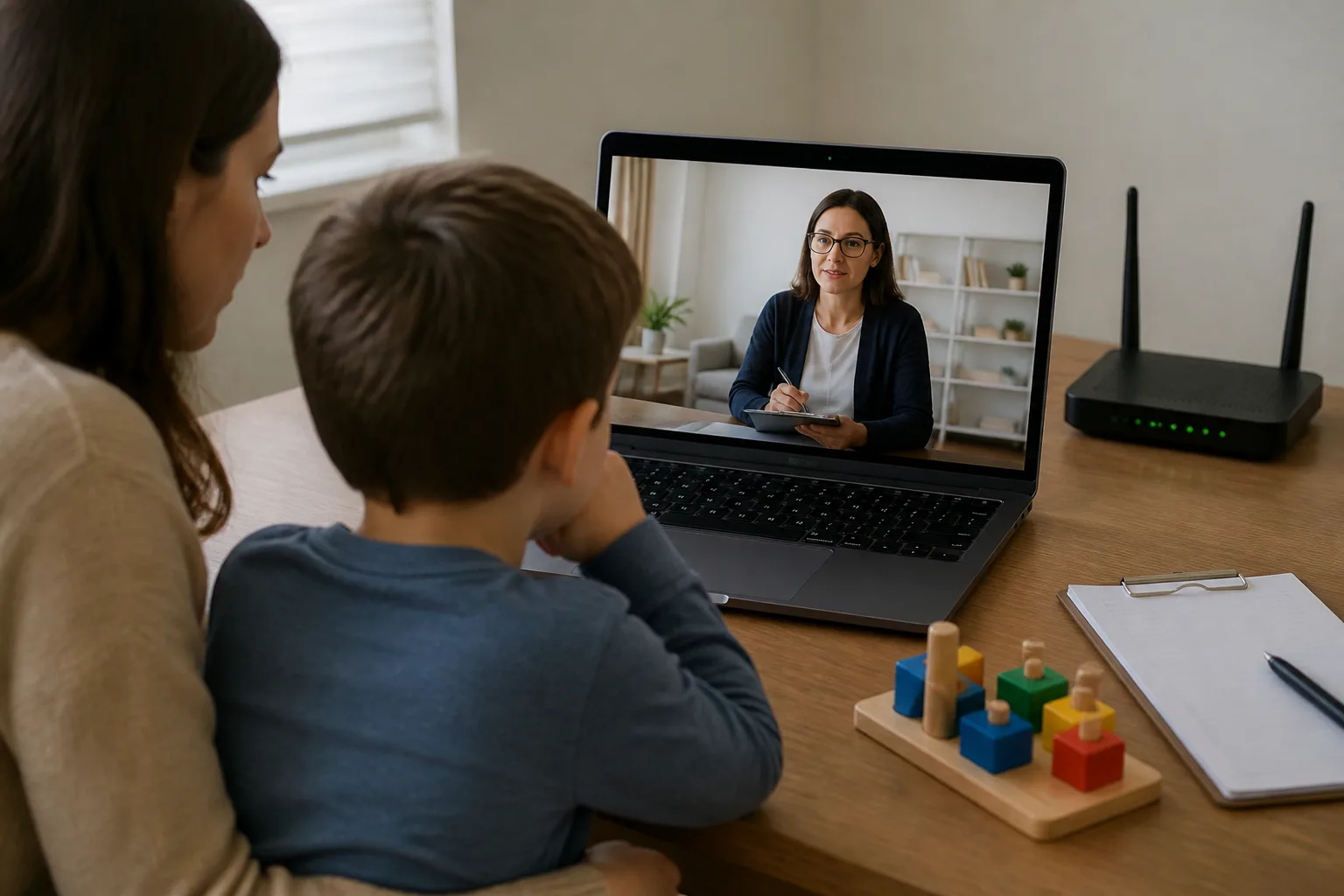
Study Explores Telehealth Autism Evaluations Amid Network Challenges: Key Technical and Clinical Insights

Telehealth Autism Assessments and Network Stability
Telehealth has become an important tool for expanding access to autism diagnostic services, especially for families in remote or underserved areas. However, the reliability of scoring behavioral observations during these evaluations depends significantly on the quality of the internet connection.
Research Overview: Simulating Network Issues
A recent pilot study published in PLoS One investigated how varying levels of network degradation affect the scoring of autism diagnostic videos. Researchers used an optical-fiber testbed to simulate controlled packet loss and Wi-Fi signal attenuation, creating four distinct video freeze patterns ranging from one-second freezes every 16.7 seconds to every 5 seconds.
They applied these freeze patterns to 40 video clips from 10 children undergoing the Brief Observation of Symptoms of Autism (BOSA) assessment. Four psychologists, blinded to the network conditions, scored the videos to evaluate the impact of technical disruptions on diagnostic reliability.
Key Findings on Scoring Reliability and Network Quality
The study found that scoring performance declined gradually as network conditions worsened rather than collapsing abruptly. Specifically, when the Received Signal Strength Indicator (RSSI) dropped below -70 dBm or packet loss exceeded approximately 0.04%, freeze frequency increased notably, from about one freeze every 16.7 seconds to one every 5 seconds.
Certain time-sensitive behaviors were more affected by video freezes. Items such as Spontaneous Joint Attention, Integration of Gaze and Behavior, Immediate Echolalia, and Stereotyped or Idiosyncratic Language were four to nine times more likely to be marked as unscorable under poorer streaming conditions. Additionally, poorer stream quality correlated with an increase in unscored items (correlation coefficient approximately -0.58).
Overall Diagnostic Stability and Clinical Implications
Despite these challenges, the overall BOSA scoring remained stable across different network conditions. No individual item showed statistically significant scoring differences after correcting for multiple comparisons. Moreover, inter-rater reliability remained high under mild network degradation, with an intraclass correlation coefficient of 0.93 and Cohen’s kappa of 0.76, indicating strong agreement among clinicians.
These findings suggest that BOSA assessments can be a reliable first-line telehealth diagnostic option when network packet loss is kept below 0.04% and signal strength stays above -70 dBm. The study authors recommend using wired internet connections when possible and being mindful of specific item sensitivities to maintain diagnostic confidence.
Limitations and Future Directions
This pilot study involved a limited sample size and controlled simulation of network issues, which may not capture the full range of real-world telehealth environments. Further research involving larger and more diverse populations is needed to validate these findings and refine guidelines for telehealth autism evaluations under varying technical conditions.
Families and clinicians considering telehealth autism assessments should be aware of the potential impact of internet quality on certain behavioral observations but can take reassurance from the overall robustness of the BOSA tool under moderate network challenges.
For more detailed information, see the original study published in PLoS One.
Download the images in this article