Study Finds Autistic Children Can Adapt Decision-Making Strategies in Visual Tasks

New Insights into Perceptual Decision-Making in Autism
Recent research has explored how autistic and non-autistic children make perceptual decisions, particularly whether autistic children can flexibly adjust their decision-making speed and accuracy based on task demands. This study, published in Attention, Perception, & Psychophysics, used advanced modeling techniques to analyze performance on visual orientation and motion tasks.
Study Design and Participants
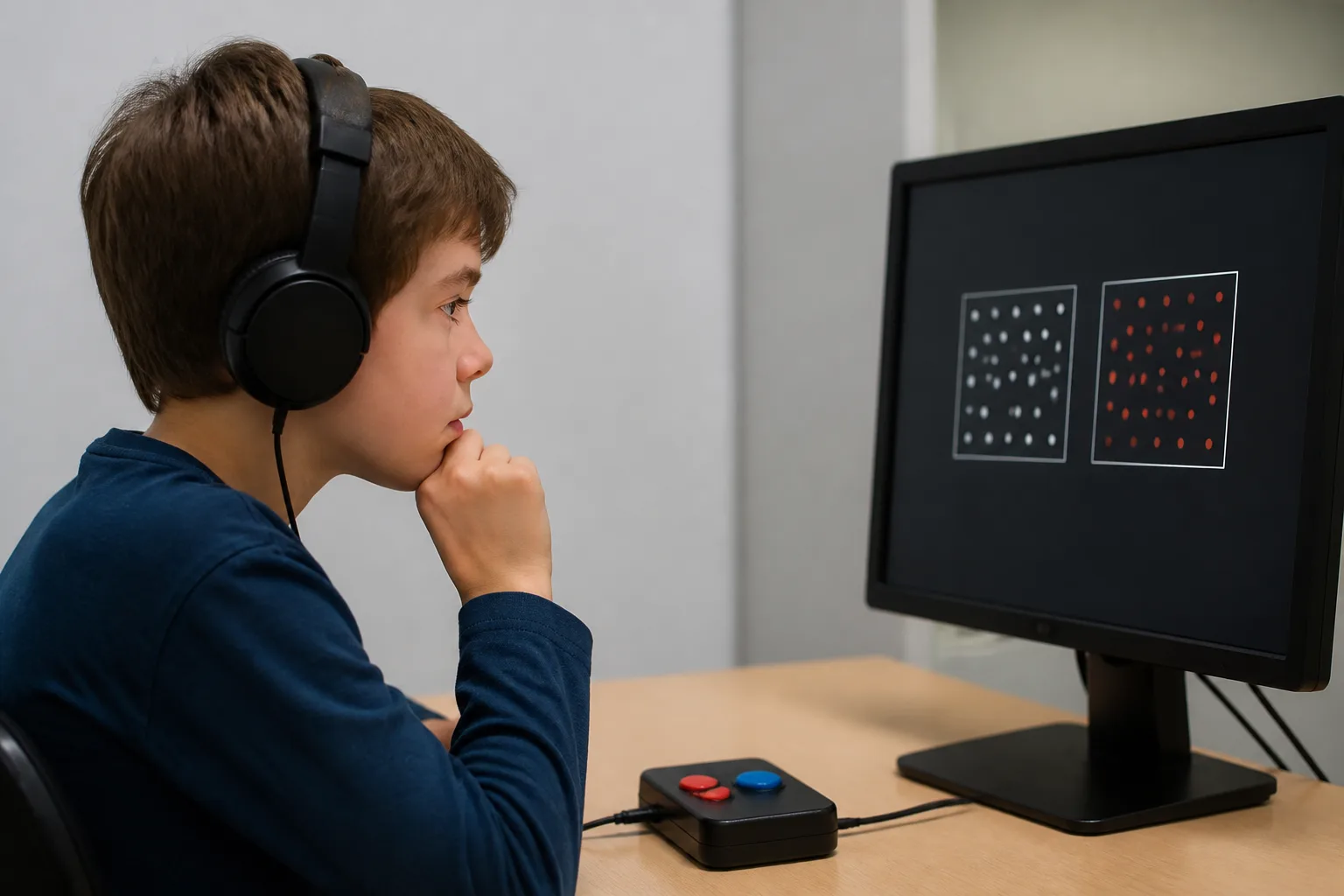
The investigation involved 100 children aged 6 to 14 years, split evenly between autistic and non-autistic groups. Participants completed two types of visual tasks: an orientation discrimination task without explicit speed or accuracy instructions, and a motion discrimination task with instructions emphasizing either speed or accuracy. This design allowed researchers to assess how task instructions influenced decision-making strategies.
Use of Diffusion Decision Models
The researchers applied Bayesian hierarchical diffusion decision models (DDMs), which go beyond traditional measures like accuracy and response time to provide a detailed understanding of the cognitive processes behind decisions. A rigorous blind modeling approach was used to avoid bias, followed by additional non-hierarchical analyses.
Key Findings
Contrary to some expectations, the study found no clear differences between autistic and non-autistic children in the parameters derived from the decision models, regardless of task type or instruction condition. Importantly, autistic children demonstrated the ability to adjust their decision-making strategies flexibly when instructed to prioritize speed or accuracy. This suggests that cognitive flexibility, often thought to be impaired in autism, may be preserved in certain decision-making contexts.
Additional Observations
The study also examined how decision-making parameters related to other traits such as attention-deficit/hyperactivity disorder (ADHD) symptoms, reading skills, sensory processing, and motor coordination. Some task-specific associations emerged, including links between sensory underresponsivity, sight-word reading ability, hyperactivity/impulsivity, and decision-making characteristics.
Implications and Future Directions
These findings highlight the importance of considering co-occurring traits and clear task instructions when studying decision-making in autism. The authors emphasize that inconsistent results in previous research may stem from differences in modeling approaches and task designs. Future studies should continue to explore the nuanced cognitive profiles within autistic populations to better understand variability in perceptual decision-making.
Access to Data and Transparency
The study was preregistered, and all de-identified data, experimental code, and analysis scripts are publicly available, supporting transparency and reproducibility in research.
For more detailed information, see the original publication: Autistic and non-autistic children’s perceptual decision-making in visual orientation and motion tasks and the effect of task instructions.
Download the images in this article