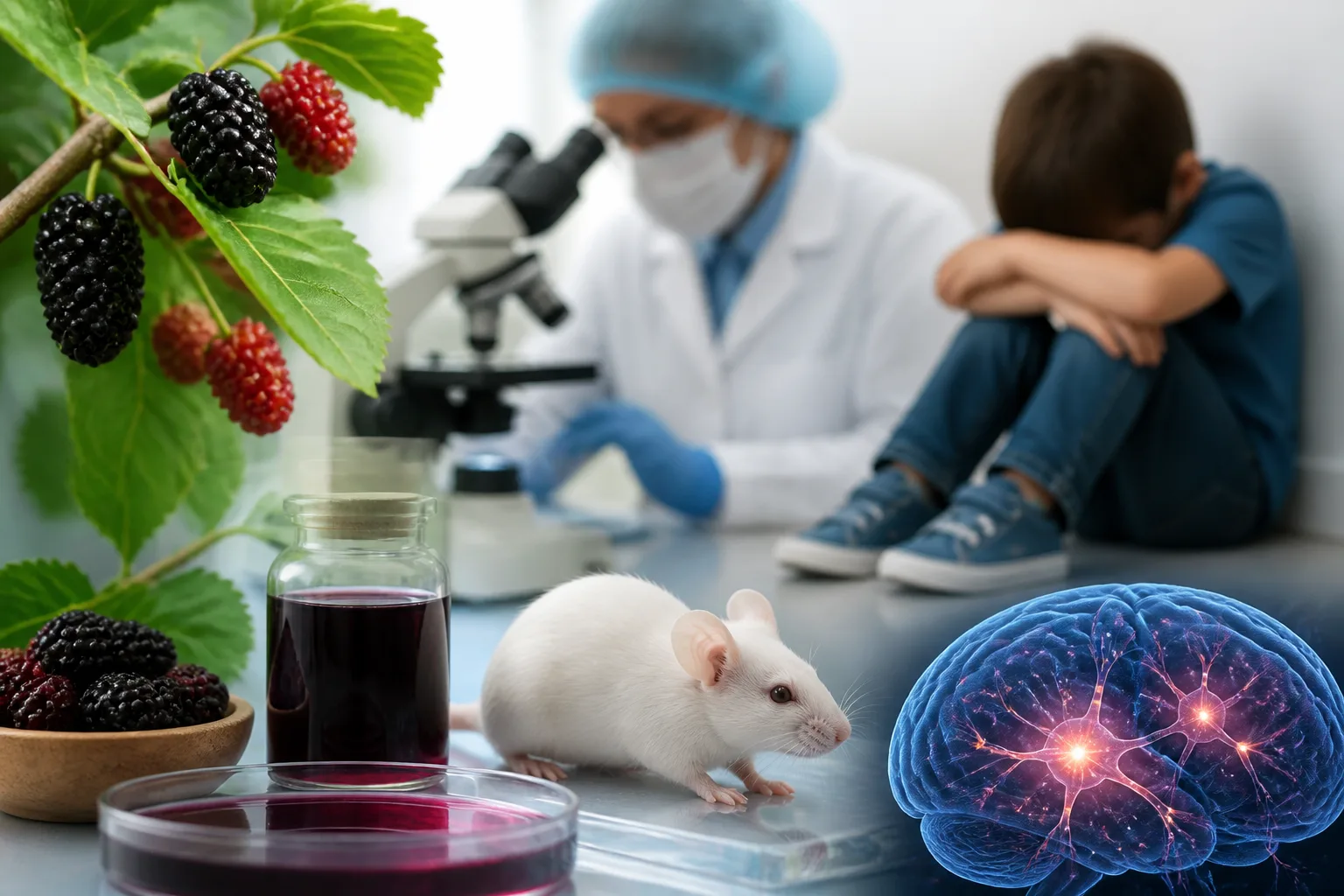
Black Mulberry Extract Shows Promise in Reducing Autistic-Like Behaviors in Mouse Model

Study Explores Potential Benefits of Morus nigra L. Extract on Autism-Related Behaviors
Autism spectrum disorder (ASD), a complex neurodevelopmental condition, currently lacks effective pharmacological treatments. Recent research has investigated the impact of early-life stress, such as maternal separation (MS), which is known to contribute to neuroinflammation and oxidative stress—factors associated with autistic-like behaviors.
A new study examined whether an extract from Morus nigra L. (black mulberry), recognized for its anti-inflammatory and antioxidant effects, could alleviate these behaviors in mice subjected to maternal separation. The findings were published in Developmental Neurobiology and provide insight into possible therapeutic avenues for ASD-related symptoms (source).
Methodology and Behavioral Assessments
The study involved 40 male NMRI mice exposed to maternal separation to induce autistic-like behaviors. Researchers administered hydroalcoholic extract of black mulberry at doses of 20, 40, or 60 mg/kg. Behavioral tests evaluated social interaction, memory, aggression, and spatial learning, including the three-chamber social test, resident-intruder aggression test, shuttle box passive avoidance test, and Morris water maze.
Key Findings: Behavioral Improvements and Biochemical Changes
Mice treated with the black mulberry extract showed notable improvements in social preference and passive avoidance memory, alongside reduced aggressive behaviors. Performance in the Morris water maze indicated enhanced spatial learning and memory capabilities.
Biochemical analyses revealed that the extract lowered oxidative stress markers such as malondialdehyde and nitrite levels in the hippocampus, while increasing total antioxidant capacity. Gene expression studies demonstrated reduced levels of pro-inflammatory cytokines, including tumor necrosis factor-alpha (Tnf-α), interleukin-1 beta (Il-1β), and toll-like receptor 4 (Tlr4), suggesting diminished neuroinflammation.
Implications for ASD Research and Future Directions
These results suggest that Morus nigra extract may mitigate autistic-like behaviors in mice by reducing neuroinflammation and oxidative stress. While promising, these findings are preliminary and derived from an animal model; further research is necessary to clarify the mechanisms involved and to determine appropriate dosing for potential clinical applications.
Considerations and Limitations
It is important to note that this study was conducted in mice, and autistic-like behaviors in animals do not fully replicate the complexity of human ASD. Additionally, the precise pathways through which black mulberry extract exerts its effects remain to be fully elucidated. Caution is advised before extrapolating these findings to human treatment.
Overall, this research contributes valuable data on the potential neuroprotective effects of natural compounds in neurodevelopmental disorders and supports continued investigation into antioxidant and anti-inflammatory strategies for ASD.
Source: Morus nigra L. Extract Mitigates Autistic-Like Behaviors in Maternally Separated Mice
Download the images in this article