Skip to content
-
Subscribe to our newsletter & never miss our best posts. Subscribe Now!
Love Beyond Words - autismwords.com Love Beyond Words - autismwords.com Love Beyond Words - autismwords.com

Supporting children with autism through education and care

Love Beyond Words - autismwords.com Love Beyond Words - autismwords.com Love Beyond Words - autismwords.com

Supporting children with autism through education and care

  • Learning & Support
    • Communication Skills
    • Daily Living Skills
    • Emotional Regulation
    • Everyday Challenges
    • Learning Through Play
    • Parent Education & Advocacy
    • Positive Behavior Support
    • Routines & Transitions
    • Social Skills
    • Speech & Language
  • Learning & Support
    • Communication Skills
    • Daily Living Skills
    • Emotional Regulation
    • Everyday Challenges
    • Learning Through Play
    • Parent Education & Advocacy
    • Positive Behavior Support
    • Routines & Transitions
    • Social Skills
    • Speech & Language
Close

Search

  • https://www.facebook.com/
  • https://twitter.com/
  • https://t.me/
  • https://www.instagram.com/
  • https://youtube.com/
Subscribe
Love Beyond Words - autismwords.com Love Beyond Words - autismwords.com Love Beyond Words - autismwords.com

Supporting children with autism through education and care

Love Beyond Words - autismwords.com Love Beyond Words - autismwords.com Love Beyond Words - autismwords.com

Supporting children with autism through education and care

  • Learning & Support
    • Communication Skills
    • Daily Living Skills
    • Emotional Regulation
    • Everyday Challenges
    • Learning Through Play
    • Parent Education & Advocacy
    • Positive Behavior Support
    • Routines & Transitions
    • Social Skills
    • Speech & Language
  • Learning & Support
    • Communication Skills
    • Daily Living Skills
    • Emotional Regulation
    • Everyday Challenges
    • Learning Through Play
    • Parent Education & Advocacy
    • Positive Behavior Support
    • Routines & Transitions
    • Social Skills
    • Speech & Language
Close

Search

  • https://www.facebook.com/
  • https://twitter.com/
  • https://t.me/
  • https://www.instagram.com/
  • https://youtube.com/
Subscribe
Home/Learning & Support/Routines & Transitions/Transition from Playtime to Snack Time: 6-Step Visual Routine for Young Children
Transition from Playtime to Snack Time: 6-Step Visual Routine for Young Children
Routines & Transitions

Transition from Playtime to Snack Time: 6-Step Visual Routine for Young Children

By Andyle
August 21, 2026 2 Min Read
0

Transitioning from playtime to snack time can be challenging for many young children, especially those who benefit from clear routines and visual supports. Using a simple visual routine helps children understand what is happening now, what comes next, and how to finish one activity before starting another. This article presents a practical 6-step visual routine to support a smooth transition from playtime to snack time, promoting predictability, communication, and gradual independence.

Why Use a Visual Routine for Transitions?

Many children, including autistic children or those with sensory or communication needs, find transitions difficult because they are uncertain about what comes next or need extra time to process changes. Visual routines provide a clear, concrete sequence of steps that children can refer to, reducing anxiety and resistance. Visuals can be combined with verbal cues, gestures, or AAC to support understanding and expression.

6 Steps to Transition from Playtime to Snack Time

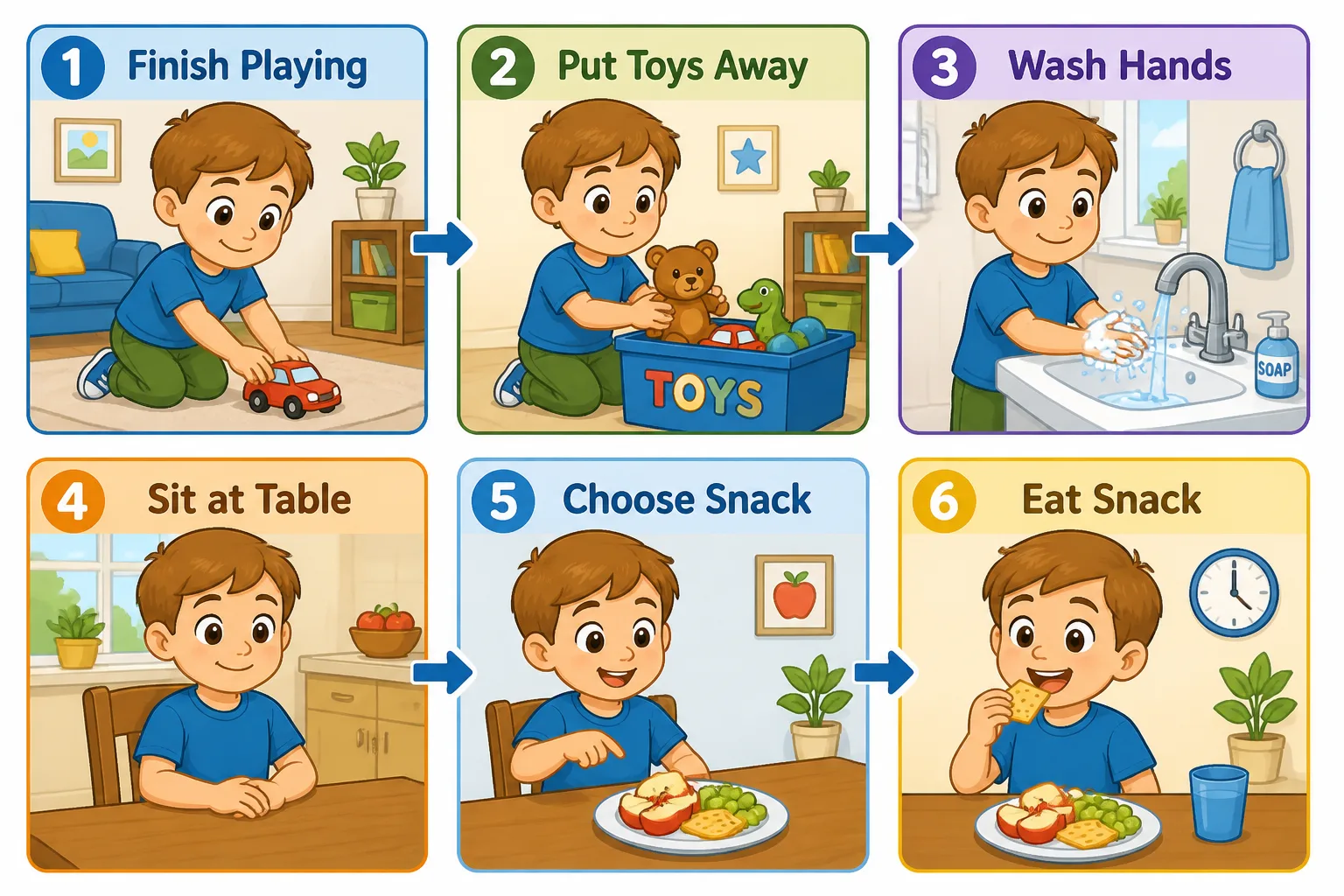
1. Finish Playing

Encourage your child to complete or pause their current play activity. Use a calm voice and simple words like “5 more minutes, then snack.” This prepares the child mentally to stop playing.

2. Put Toys Away

Help your child put toys back into their designated places. This step teaches responsibility and signals the end of playtime. Use clear labels or pictures on toy boxes if helpful.

3. Wash Hands

Guide your child to wash their hands with soap and water. This step supports hygiene and creates a natural break between activities.

4. Sit at Table

Invite your child to sit at the snack table or kitchen area. Use consistent phrases like “sit down for snack time.” Visual timers or countdowns can help if waiting is involved.

5. Choose Snack

Offer your child a choice between two or three healthy snack options. Giving choices supports autonomy and reduces resistance.

6. Eat Snack

Encourage your child to enjoy their snack. Praise participation and use positive reinforcement to build routine confidence.

Supporting Your Child Through This Transition

Preview the visual routine before starting the transition to help your child anticipate what will happen. Use consistent, simple language and give advance warnings like “First finish playing, then snack.” Allow your child time to process each step and offer choices when possible. Praise their efforts and participation to build positive associations.

For children who benefit from sensory support during transitions, consider pairing this routine with strategies like preparing for loud events or using a calm voice as described in Using a Calm Voice: 5 Positive Steps for Young Children.

Conclusion

A clear, step-by-step visual routine for transitioning from playtime to snack time helps children understand and manage change with confidence. By breaking the process into manageable actions and supporting communication, parents and caregivers can reduce stress and foster independence.

What is your favorite way to help your child transition to snack time? Share your tips and experiences!

Descarga las imágenes de esta rutina de transición

  • Transition from Playtime to Snack Time: 6-Step Visual Routine for Young Children

Tags:

child transitionscommunication supportindependencepredictable routinessnack time routinetransition from playtime to snack timevisual routineyoung children
Author

Andyle

Follow Me
Other Articles
Using a Calm Voice: 5 Positive Steps for Young Children
Previous

Using a Calm Voice: 5 Positive Steps for Young Children

Asking for Help: 6 Clear Steps to Support Your Child's Social Skills
Next

Asking for Help: 6 Clear Steps to Support Your Child’s Social Skills

No Comment! Be the first one.

Leave a Reply Cancel reply

Your email address will not be published. Required fields are marked *

AAC asking for help autism support calming strategies child-centered care child development child independence children child transitions collaborating with school communication communication skills communication support coping strategies daily living skills documenting progress early childhood education early learning emotional regulation emotional skills frustration handling frustration independence language development parent advocacy parenting tips parent tips personal boundaries personal hygiene positive behavior support predictable routines replacement skills self-advocacy self-care skills sensory support snack time routine social skills spatial relationships transition from playtime to snack time treasure hunt using a calm voice visual learning visual routine visual supports young children

  • Asking for Help: 6 Clear Steps to Support Your Child's Social Skills
    Asking for Help: 6 Clear Steps to Support Your Child’s Social Skills
    Learn how to teach young children the important social skill of asking for help with 6 clear steps. Support communication with speech, gestures, or AAC.
  • Transition from Playtime to Snack Time: 6-Step Visual Routine for Young Children
    Transition from Playtime to Snack Time: 6-Step Visual Routine for Young Children
    Help your child smoothly transition from playtime to snack time with a clear 6-step visual routine. Support predictability, communication, and independence.
  • Using a Calm Voice: 5 Positive Steps for Young Children
    Using a Calm Voice: 5 Positive Steps for Young Children
    Help your child learn to use a calm voice with 5 positive steps: notice feelings, take a deep breath, use a quiet voice, ask for help, and say "I'm trying!"
  • Preparing for Loud Events: 6 Sensory Support Steps for Children
    Preparing for Loud Events: 6 Sensory Support Steps for Children
    Learn 6 practical sensory support steps to help children prepare for loud events. Teach recognition, communication, breaks, and choices for comfort and confidence.
  • Color Sorting Treasure Hunt: A Fun Learning Through Play Activity
    Color Sorting Treasure Hunt: A Fun Learning Through Play Activity
    Engage your child with a playful color sorting treasure hunt that builds color recognition, matching, and motor skills in six fun, easy steps.
Expressing Discomfort and Asking for Help: 6 Essential Communication Phrases for Young Expressing Discomfort and Asking for Help: 6 Essential Communication Phrases for Young Children
29 views
Preparing for Loud Events: 6 Sensory Support Steps for Children Preparing for Loud Events: 6 Sensory Support Steps for Children
20 views
Using a Calm Voice: 5 Positive Steps for Young Children Using a Calm Voice: 5 Positive Steps for Young Children
17 views
Handling Frustration: 6 Positive Steps for Young Children Handling Frustration: 6 Positive Steps for Young Children
12 views
Preparing for a Doctor Visit with Your Child: 6 Parent Steps for Preparing for a Doctor Visit with Your Child: 6 Parent Steps for Success
12 views

Content on this website is created with the assistance of artificial intelligence (AI), while some portions are still reviewed and overseen by humans. All content and resources are provided completely free of charge.

Some information may be referenced or cited from reputable sources. Whenever possible, we will clearly identify the sources used within each article.

If you have any questions, feedback, or would like to contact us, please email: info@autismwords.com

Copyright 2026 — Love Beyond Words - autismwords.com. All rights reserved. Blogsy WordPress Theme