Skip to content
Love Beyond Words - autismwords.com Love Beyond Words - autismwords.com Love Beyond Words - autismwords.com

Supporting children with autism through education and care

Love Beyond Words - autismwords.com Love Beyond Words - autismwords.com Love Beyond Words - autismwords.com

Supporting children with autism through education and care

  • Learning & Support
    • Communication Skills
    • Daily Living Skills
    • Emotional Regulation
    • Everyday Challenges
    • Learning Through Play
    • Parent Education & Advocacy
    • Positive Behavior Support
    • Routines & Transitions
    • Social Skills
    • Speech & Language
  • Autism News & Perspectives
  • Hero News
  • Learning & Support
    • Communication Skills
    • Daily Living Skills
    • Emotional Regulation
    • Everyday Challenges
    • Learning Through Play
    • Parent Education & Advocacy
    • Positive Behavior Support
    • Routines & Transitions
    • Social Skills
    • Speech & Language
  • Autism News & Perspectives
  • Hero News
Close

Search

  • https://www.facebook.com/
  • https://twitter.com/
  • https://t.me/
  • https://www.instagram.com/
  • https://youtube.com/
Love Beyond Words - autismwords.com Love Beyond Words - autismwords.com Love Beyond Words - autismwords.com

Supporting children with autism through education and care

Love Beyond Words - autismwords.com Love Beyond Words - autismwords.com Love Beyond Words - autismwords.com

Supporting children with autism through education and care

  • Learning & Support
    • Communication Skills
    • Daily Living Skills
    • Emotional Regulation
    • Everyday Challenges
    • Learning Through Play
    • Parent Education & Advocacy
    • Positive Behavior Support
    • Routines & Transitions
    • Social Skills
    • Speech & Language
  • Autism News & Perspectives
  • Hero News
  • Learning & Support
    • Communication Skills
    • Daily Living Skills
    • Emotional Regulation
    • Everyday Challenges
    • Learning Through Play
    • Parent Education & Advocacy
    • Positive Behavior Support
    • Routines & Transitions
    • Social Skills
    • Speech & Language
  • Autism News & Perspectives
  • Hero News
Close

Search

  • https://www.facebook.com/
  • https://twitter.com/
  • https://t.me/
  • https://www.instagram.com/
  • https://youtube.com/
Home/Autism News & Perspectives/New Insights into Neurodevelopmental Disorders: The Role of Perinatal Factors and Genetic Vulnerability
New Insights into Neurodevelopmental Disorders: The Role of Perinatal Factors and Genetic
Autism News & Perspectives

New Insights into Neurodevelopmental Disorders: The Role of Perinatal Factors and Genetic Vulnerability

By Michael Pham
October 14, 2026 2 Min Read
0

Understanding Neurodevelopmental Disorders and Their Origins

Neurodevelopmental disorders (NDDs), such as autism spectrum disorder (ASD), attention-deficit/hyperactivity disorder (ADHD), intellectual disability (ID), epilepsy, and schizophrenia, impact roughly 10-15% of children globally. Recent research highlights that these conditions often result from complex interactions between genetic predispositions and environmental influences, especially those occurring around the time of birth.

Key Findings from Recent Review

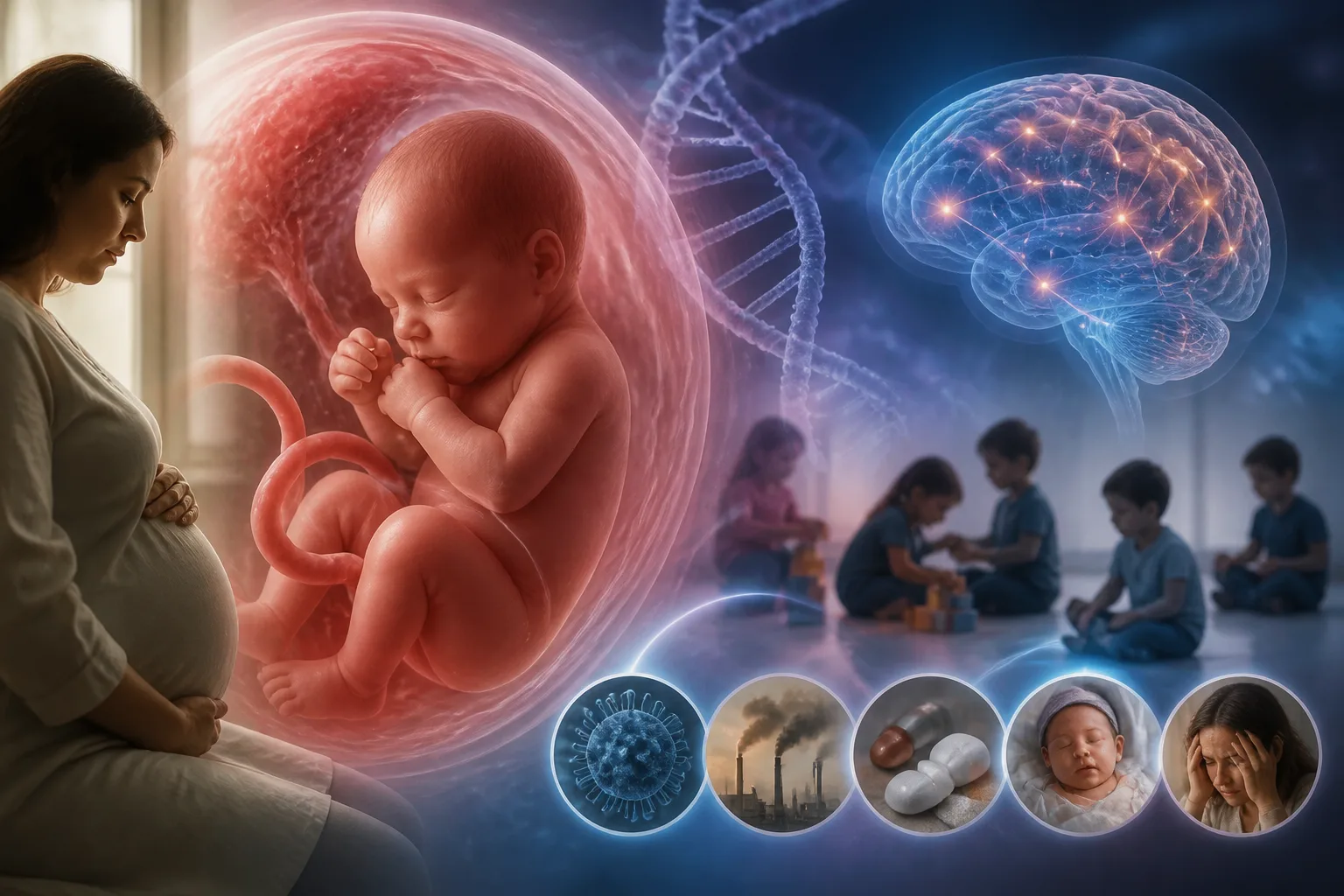
A comprehensive narrative review published in Translational Pediatrics synthesizes evidence on how perinatal insults and genetic susceptibility converge to influence the development of NDDs. The authors examined studies from 2000 to 2026, prioritizing human research and integrating findings from genetics, epigenetics, and neurobiology.

Genetic Contributions

The review outlines the genetic architecture of NDDs, ranging from rare genetic variants to the cumulative effects of many genes (polygenic risk). It emphasizes the importance of distinguishing genuine gene-environment interactions from confounding genetic factors.

Epigenetic Mechanisms

Epigenetic changes—including DNA methylation, histone modifications, and noncoding RNAs—are proposed as crucial molecular mediators. These changes may translate early environmental insults into long-lasting alterations in brain function.

Neural Circuit Dysfunction

The authors describe how disruptions at the synaptic and ion channel levels can cascade into broader neural circuit dysfunctions involving key brain regions such as the cortex, cerebellum, thalamus, and brainstem. This neural disruption underlies many symptoms observed in NDDs.

Therapeutic Implications

Emerging treatment strategies are discussed, with a focus on translational approaches that consider developmental timing and individual genetic profiles. The review advocates for precision medicine tailored to genetically defined subgroups.

Context and Future Directions

Despite advances, the review identifies significant gaps, including ancestry bias in genomic studies, the absence of unified risk models, and challenges in translating findings into therapies. It calls for more diverse genomic cohorts, multi-omic birth studies, early biomarkers for perinatal risk, and clinical trials targeting specific genetic profiles.

What This Means for Families and Clinicians

This integrative framework enhances understanding of how early-life factors and genetics jointly influence neurodevelopment. It underscores the potential for early detection and intervention during critical developmental windows, which could improve outcomes for children at risk of NDDs.

Limitations and Cautions

While the review offers a robust synthesis, it remains a narrative overview rather than a systematic meta-analysis. The complex interplay of genetics and environment requires cautious interpretation, and more research is needed to confirm causal pathways and effective interventions.

For more detailed information, see the original review article at PubMed.

Download the images in this article

  • New Insights into Neurodevelopmental Disorders: The Role of Perinatal Factors and Genetic

Tags:

ADHDautism spectrum disorderepigeneticsgenetic susceptibilityneural circuitsneurodevelopmental disordersperinatal insultsprecision medicine
Author

Michael Pham

Follow Me
Other Articles
Emerging Technologies Offer New Opportunities for Autism Screening and Support with Focus
Previous

Emerging Technologies Offer New Opportunities for Autism Screening and Support with Focus on Equity

New Cases Expand Understanding of CBX1-Related Neurodevelopmental Syndrome
Next

New Cases Expand Understanding of CBX1-Related Neurodevelopmental Syndrome

No Comment! Be the first one.

Leave a Reply Cancel reply

Your email address will not be published. Required fields are marked *

ADHD ASD autism autism communication autism diagnosis autism parenting autism research autism spectrum disorder autism support autistic adults autistic children child communication child development child health child independence communication communication skills communication support communication supports communication tools coping strategies daily living skills early intervention emotional regulation fine motor skills Functional Communication intellectual disability language development learning through play mental health mouse model neurodevelopment neurodevelopmental disorders neurodiversity neuroinflammation parent advocacy positive behavior support sensory accommodations sensory needs sensory processing sensory support sex differences visual learning set visual routine young children

  • Study Highlights Social Disadvantages Impacting Health of Autistic Adults Without Intellectual Disability
    Study Highlights Social Disadvantages Impacting Health of Autistic Adults Without Intellectual Disability
    A UK study finds autistic adults without intellectual disability face social disadvantages that contribute to higher chronic illness and mortality risks, highlighting the need for systemic policy changes.
  • Exploratory Study Uses fNIRS and Machine Learning to Differentiate Autism in Young
    Exploratory Study Uses fNIRS and Machine Learning to Differentiate Autism in Young Children
    A study explored using functional near-infrared spectroscopy (fNIRS) with machine learning to classify autism in children aged 2-6, finding modest accuracy and no significant diagnostic advantage beyond age and sex.
  • New Framework Introduced to Evaluate Autism Support Through a Neurodiversity-Affirming Lens
    New Framework Introduced to Evaluate Autism Support Through a Neurodiversity-Affirming Lens
    A new five-principle framework offers a way to evaluate autism support research that respects neurodiversity, focusing on strengths, autonomy, communication, and sensory differences.
  • Exploring the Impact of Maternal Microbiota on Fetal Brain Development and Childhood
    Exploring the Impact of Maternal Microbiota on Fetal Brain Development and Childhood Outcomes
    A new review highlights how the maternal gut microbiota may influence fetal brain development and neurobehavioral outcomes, emphasizing key biological pathways and nutritional factors.
  • New Parent Guide Developed to Support Sleep in Children with Autism Through
    New Parent Guide Developed to Support Sleep in Children with Autism Through Holistic Self-Regulation Strategies
    Researchers have created and validated a parent guide that uses holistic self-regulation strategies to support sleep improvement in children with autism spectrum disorder, highlighting a multidimensional approach involving the child, environment, and sleep factors.
Study Highlights Social Disadvantages Impacting Health of Autistic Adults Without Intellectual Disability
October 15, 2026
Exploratory Study Uses fNIRS and Machine Learning to Differentiate Autism in Young
Exploratory Study Uses fNIRS and Machine Learning to Differentiate Autism in Young Children
October 15, 2026
New Framework Introduced to Evaluate Autism Support Through a Neurodiversity-Affirming Lens
October 15, 2026
Exploring the Impact of Maternal Microbiota on Fetal Brain Development and Childhood
Exploring the Impact of Maternal Microbiota on Fetal Brain Development and Childhood Outcomes
October 15, 2026
Study Reveals Sex-Specific Behavioral Changes in Mice Lacking α5-Nicotinic Acetylcholine Receptors
155 views
Preparing for Loud Events: 6 Sensory Support Steps for Children
136 views
Expressing Discomfort and Asking for Help: 6 Essential Communication Phrases for Young
Expressing Discomfort and Asking for Help: 6 Essential Communication Phrases for Young Children
130 views
Feeling Worried: 6 Steps to Help Young Children Recognize and Manage Worry
127 views
Using a Calm Voice: 5 Positive Steps for Young Children
126 views

Content on this website is created with the assistance of artificial intelligence (AI), while some portions are still reviewed and overseen by humans. All content and resources are provided completely free of charge.

Some information may be referenced or cited from reputable sources. Whenever possible, we will clearly identify the sources used within each article.

If you have any questions, feedback, or would like to contact us, please email: info@autismwords.com

Copyright 2026 — Love Beyond Words - autismwords.com. All rights reserved. Blogsy WordPress Theme

Join Us on the Journey to Understanding Autism

Subscribe to receive curated autism knowledge, lessons, and the latest news — delivered to you regularly.

We promise to send only helpful autism-related information and knowledge — no ads, no spam. You can unsubscribe anytime.

Thank you for subscribing!