Study Reveals Differences in Brain Responses to Audiovisual Speech in Autistic and Non-Autistic Children

New Insights into Audiovisual Speech Processing in Autism
Recent research has identified distinct patterns in how autistic and non-autistic children process audiovisual speech, using advanced brainwave analysis techniques. These findings may enhance understanding of sensory integration differences in autism.
Study Overview
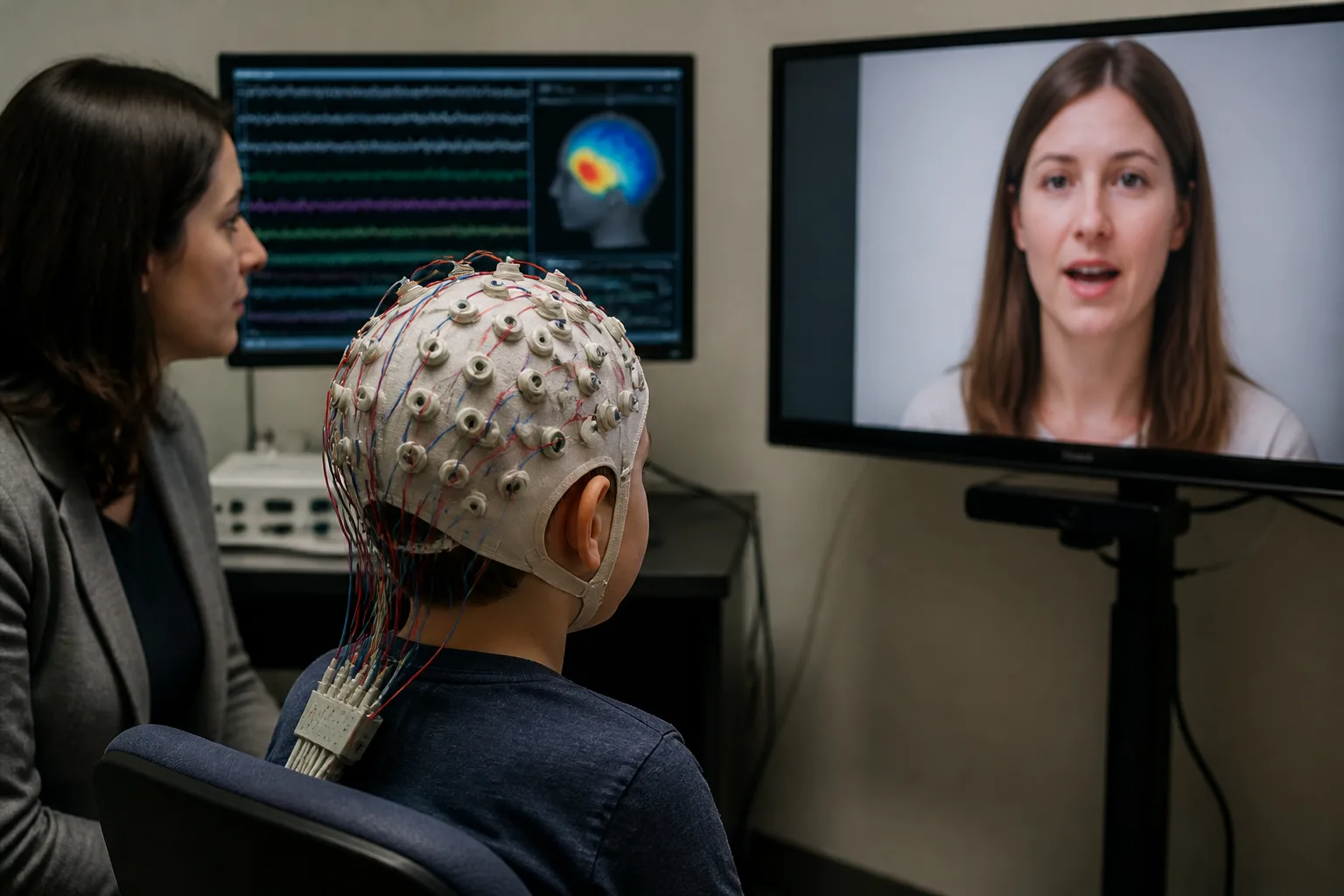
The study analyzed event-related potentials (ERPs), which are brain responses measured by electroencephalography (EEG), recorded while children listened to and watched speech stimuli. Unlike previous work that examined conventional ERP measures, this research employed data-driven, reference-independent metrics to assess both the strength and spatial distribution (topography) of brain responses.
Participants and Methods
Researchers examined existing ERP data from 50 children aged 5 to 12 years, evenly divided into autistic and non-autistic groups matched by age and sex assigned at birth. During a passive task, participants were exposed to auditory-only and audiovisual speech syllables while their brain activity was recorded.
The analysis focused on two key metrics: global field power (GFP), indicating the overall strength of the ERP signal, and global map dissimilarity (GMD), reflecting differences in the spatial pattern of brain activation.
Key Findings
The study found that the ERP strength (GFP) was significantly lower when children processed audiovisual speech compared to auditory-only speech, specifically between 245 and 275 milliseconds after stimulus onset. This reduction suggests a facilitation effect from integrating visual and auditory information, observed in both autistic and non-autistic children.
Importantly, differences between the groups emerged in the topography of ERPs (GMD) during an earlier time window of 139 to 170 milliseconds post-stimulus. These differences were linked primarily to variations in occipital brain regions, which are associated with visual processing.
Implications for Understanding Autism
These results indicate that while both autistic and non-autistic children benefit from audiovisual speech integration, autistic children exhibit distinct neural activation patterns during this process. The use of topographic ERP analysis offers a promising approach to further explore sensory processing differences in autism spectrum disorder.
Considerations and Future Directions
Although this study advances knowledge of audiovisual speech processing in autism, it does not establish causal relationships and is limited to school-aged children within a specific age range. Further research is needed to explore how these neural differences relate to language development and communication skills across broader populations.
For more detailed information, see the original publication at PubMed.
Download the images in this article