New Framework Links Brain Timing, Motor Skills, and Social Development in Autism Spectrum Disorder

Understanding Early Development in Autism
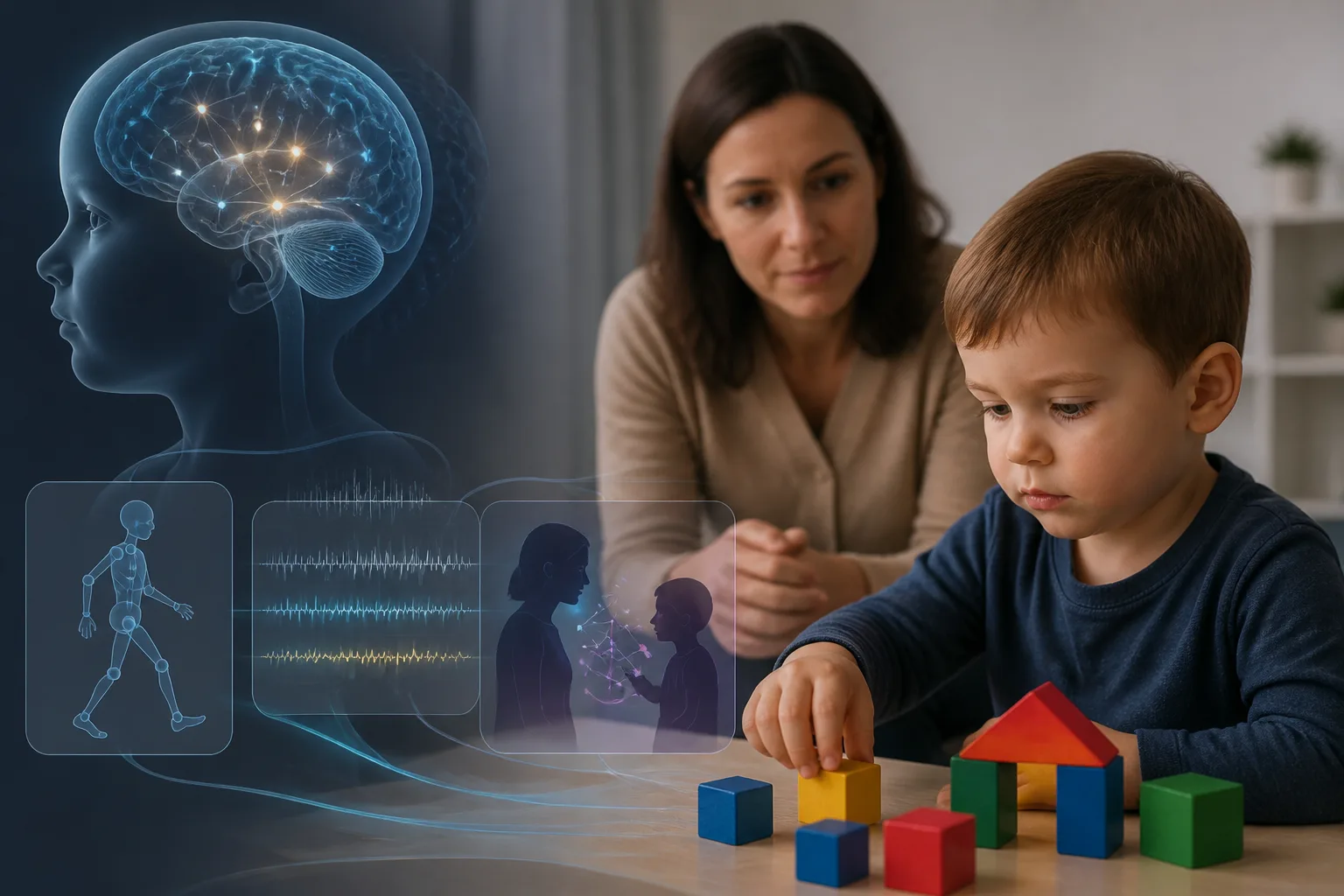
Recent research proposes a novel framework that connects brain hemisphere specialization, motor coordination, and social interaction timing to better understand early developmental differences seen in autism spectrum disorder (ASD). This approach moves beyond examining motor, sensory, and social behaviors in isolation, instead considering how these systems interact as part of a developing neurobiological network.
Key Components of the Framework
The framework integrates findings from fetal to early childhood stages, focusing on how several neural and behavioral factors may influence social development trajectories. These factors include:
- Hemispheric specialization and interhemispheric coordination: How the brain’s two halves develop distinct but coordinated functions.
- Oscillatory synchronization: Neural timing patterns that support communication within the brain.
- Corticalization of motor control: The maturation of brain regions governing movement.
- Dyadic interaction timing: The timing and synchrony of social exchanges between infants and caregivers.
Indicators of Neural Timing Variation
The researchers highlight several developmental markers that may reflect differences in neural timing and coordination, including persistent primitive reflexes, unusual motor asymmetry (differences in movement between sides of the body), increased variability in motor skills, and altered synchrony in social interactions. These markers could signal broader variations in how neural systems develop and interact.
Implications for Autism Risk Factors
This framework also considers how genetic, neurobiological, and environmental factors linked to ASD risk might converge on processes regulating developmental timing. Instead of suggesting a direct cause-and-effect relationship, the model emphasizes how variations in motor and social interactions can influence learning opportunities through ongoing cycles of action, perception, prediction, and caregiver feedback.
Future Research Directions
The authors propose a series of testable hypotheses to be explored in longitudinal studies. They suggest that early differences in neural timing and coordination will correlate with variations in motor organization and motor-social coupling, which may subsequently relate to social developmental outcomes. This approach aims to generate new insights into how early brain and behavior patterns interact rather than to provide a definitive cause of ASD.
Conclusion
By focusing on developmental timing and coordination across neural, motor, and interpersonal systems, this conceptual framework offers a comprehensive perspective on early autism-related behaviors. It serves as a hypothesis-generating model to guide future research and deepen understanding of the complex interplay underlying social development in ASD.
For more detailed information, see the original study published in the Journal of Integrative Neuroscience: source.
Download the images in this article