Neuroligin 3 Reveals Sex-Specific Brain Circuits Influencing Social Spacing in Fruit Flies

Neuroligin 3 and Social Behavior in Drosophila
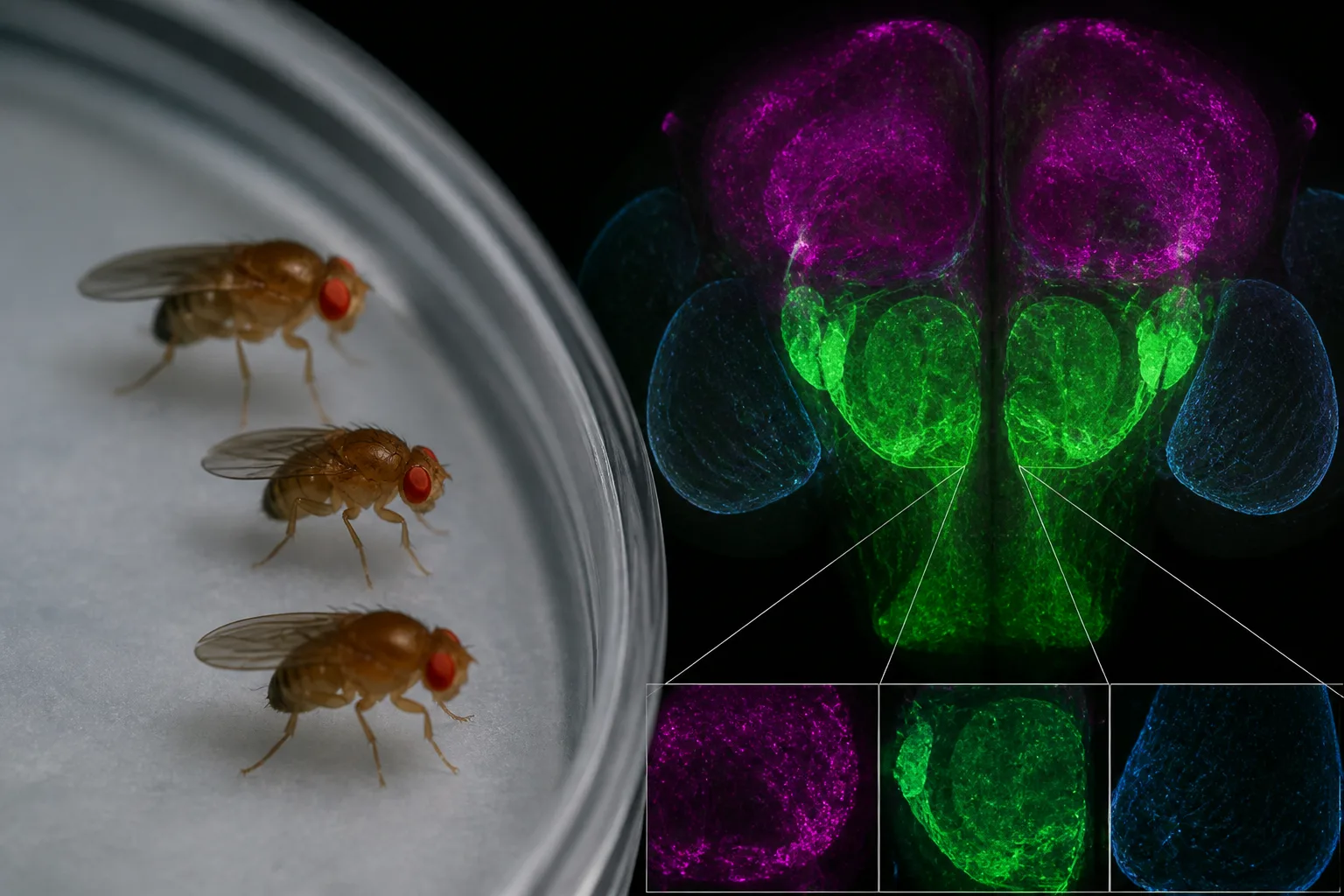
Recent research has shed light on how the protein Neuroligin 3 (Nlg3) influences social spacing behavior in the fruit fly Drosophila melanogaster. Nlg3 is a postsynaptic membrane protein known to play a role in synapse development. Its human equivalents have been linked to autism spectrum disorders, making this study relevant for understanding social behavior mechanisms across species.
Brain Regions Involved in Social Spacing
Scientists localized Nlg3 expression to three key brain areas in fruit flies: the mushroom bodies (MB) calyx, the optic lobes (OL), and the protocerebral bridge (PB). By selectively reducing Nlg3 levels in each of these regions through RNA interference, the researchers observed changes in social spacing similar to those seen when Nlg3 was knocked down throughout all Nlg3-expressing neurons. This suggests that each of these brain structures independently contributes to social spacing behavior.
Sex Differences in Neural Circuit Activation
Manipulating the activity of all Nlg3-expressing neurons revealed sex-specific effects on social spacing. When these neurons were hyperactivated or silenced, female flies tended to increase the distance between themselves and others. In males, however, social spacing only increased following hyperactivation, not silencing. This points to distinct neural mechanisms underlying social behavior in male and female flies.
Neurotransmitter Systems and Social Behavior
The study further explored the role of neurotransmitters in the mushroom bodies. Reducing acetylcholine release by targeting choline acetyltransferase (ChAT) led to decreased social spacing in both sexes. Conversely, knocking down dopamine receptors in the mushroom bodies mainly increased social spacing in males. These findings indicate that acetylcholine and dopamine signaling contribute differently to social spacing depending on sex.
Fruitless Neurons and Sexually Dimorphic Behaviors
The researchers also examined neurons expressing the gene fruitless (fruP1), which are known to regulate sexually dimorphic behaviors in fruit flies. Hyperactivating these fruP1 neurons reduced social spacing in both males and females, whereas silencing them increased social spacing only in males. This highlights the importance of fruP1 neurons in modulating social distance in a sex-dependent manner.
Implications for Understanding Social Behavior
These findings emphasize that social spacing in fruit flies is governed by a complex interplay of brain regions and neurotransmitter systems that operate differently in males and females. The involvement of Nlg3 and fruP1 neurons in these processes provides insight into the neural substrates of social behavior, with potential parallels in other species, including humans.
Considerations and Future Directions
While this research advances our understanding of the neural basis of social spacing, it is important to recognize that these findings are based on fruit fly models. The precise mechanisms and their applicability to human social behavior require further investigation. Additionally, the study highlights associations rather than direct causation, and more work is needed to unravel the detailed pathways involved.
For more detailed information, see the original study published in Genetics: Neuroligin 3 highlights the sexually dimorphic neural substrates of Drosophila social spacing.
Download the images in this article