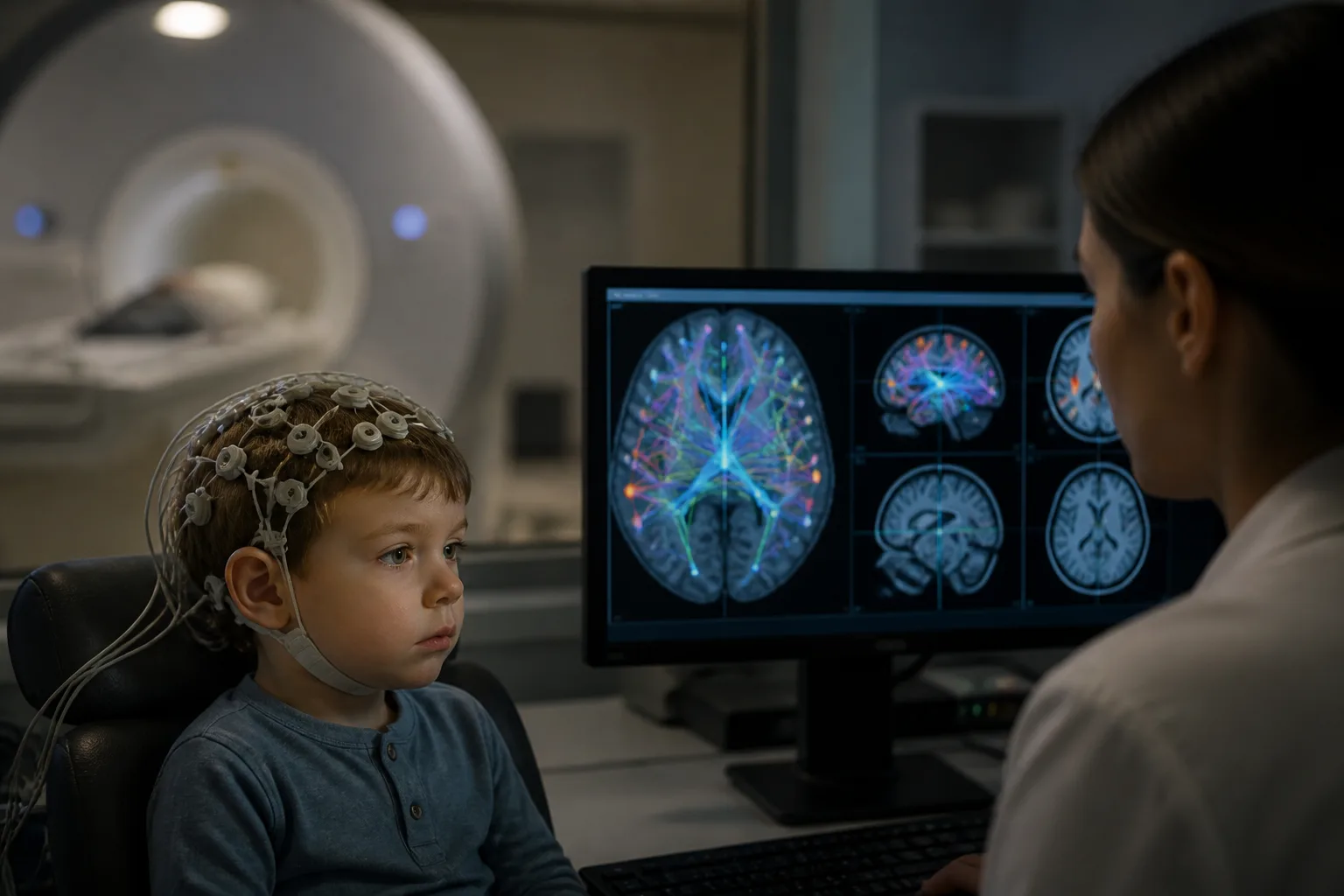
Brain Connectivity Patterns May Help Predict Social Skills in Young Children with Autism

New Study Links Brain Networks to Social Functioning in Autism
Researchers have identified specific patterns of brain connectivity that relate to differences in social abilities among young children diagnosed with autism spectrum disorder (ASD). Using advanced brain imaging and predictive modeling techniques, the study offers insights into the neural underpinnings of social behavior variability in this population.
Key Findings from Functional MRI Analysis
The study analyzed resting-state functional MRI (fMRI) data from 65 children with ASD, aged between 1.5 and 8 years (average age approximately 4.2 years). The researchers applied connectome-based predictive modeling to assess whether intrinsic brain network connections could predict individual scores on the personal-social subscale of the Griffiths Development Scales (GDS), a measure of social functioning.
Results indicated that whole-brain functional connectivity was significantly associated with social functioning scores. Specifically, a “positive predictive network”—characterized mainly by connections within the brain’s default mode network (DMN)—was strongly linked to better social skills. Within this network, the left precuneus region emerged as a central hub. Conversely, a “negative predictive network,” involving connections primarily between the frontoparietal and sensorimotor networks, was associated with lower social functioning scores.
Validation in an Independent Group
To test the robustness of these findings, the researchers examined a separate group of 27 children with ASD, aged 1.25 to 8 years (average age about 3.3 years). In this cohort, the positive-edge model—reflecting the within-DMN connections—remained significantly associated with personal-social scores, while the negative-edge and combined models did not show significant predictive power.
Implications for Understanding Autism Heterogeneity
Autism is known for its wide variability in social abilities, and this study highlights how large-scale brain network organization may underlie these individual differences. The identification of specific connectivity patterns linked to social functioning suggests that network-level brain analyses could contribute to more personalized approaches in autism research and intervention.
Considerations and Future Directions
While the findings are promising, the study’s sample size and age range should be considered when interpreting the results. Further research is needed to explore how these brain connectivity patterns develop over time and how they relate to other aspects of autism. Additionally, the study does not establish causation but rather associations between brain networks and social skills.
Overall, this research advances our understanding of the neural basis of social functioning variability in young children with ASD and supports the potential for precision medicine approaches tailored to individual neurodevelopmental profiles.
For more detailed information, see the original study published in Psychiatry Research: https://pubmed.ncbi.nlm.nih.gov/42892189/.
Download the images in this article