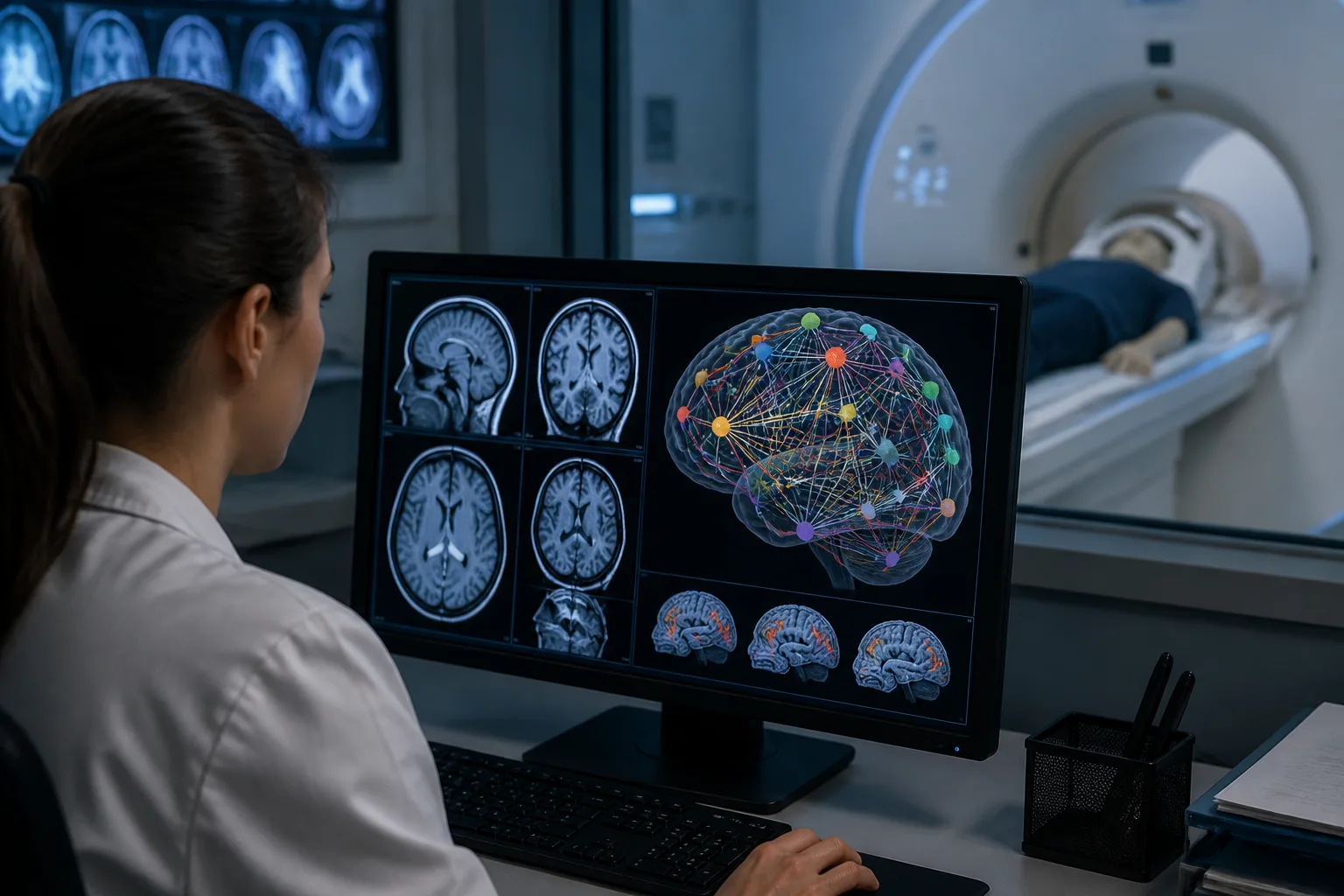

Innovative Approach to Brain Disorder Classification
A recent study introduces a novel computational model aimed at improving the identification of brain disorders through analysis of resting-state functional magnetic resonance imaging (rs-fMRI) data. This model advances previous methods by dynamically capturing brain activity patterns and incorporating the brain’s modular organization, which is linked to cognitive functions and neurological diseases.
Limitations of Traditional Brain Connectivity Models
Resting-state fMRI records spontaneous neural activity by measuring blood-oxygen-level-dependent (BOLD) signals. Functional connectivity (FC) between brain regions derived from these signals is commonly represented as functional brain graphs (FBGs). However, conventional approaches often rely on static FBGs based on a single brain atlas, which restricts their ability to reflect the temporal fluctuations of brain activity and to integrate diverse anatomical information. Additionally, these methods frequently overlook the modular architecture of brain networks, an important aspect related to brain function and pathology.
Modularity-Constrained Dynamic Functional Brain Graph Learning
To overcome these challenges, researchers developed a modularity-constrained dynamic FBG learning framework. This approach constructs FBGs from multiple brain atlases and employs a sliding window technique combined with a Transformer encoder to capture dynamic spatio-temporal patterns in brain connectivity. The model utilizes a stochastic block model (SBM) to identify modular structures within the brain networks and incorporates modularity constraints into its training process. These constraints aim to improve the interpretability of the model and provide regularization during learning.
Performance on Autism and Depression Datasets
The model was tested on two large-scale datasets: the Autism Brain Imaging Data Exchange (ABIDE) and the REST-meta-MDD Consortium (REST-MDD). It achieved classification accuracies of 68.5% for autism spectrum disorder and 65.3% for major depressive disorder, outperforming traditional and other advanced deep learning methods. These results suggest that the proposed framework can more effectively capture the dynamic functional connectivity patterns relevant to brain disorders.
Implications for Clinical Research and Practice
This dynamic and modularity-aware modeling approach offers a promising direction for understanding the complex functional organization of the brain in health and disease. By integrating multiple sources of anatomical information and emphasizing the brain’s modular structure, it may provide clinicians and researchers with improved tools for diagnosis and monitoring of neurological and psychiatric conditions.
Considerations and Future Directions
While the model shows improved classification performance, the accuracies indicate that further refinement and validation are needed before clinical application. Additionally, the findings are based on group-level data and may not directly translate to individual diagnosis. Future research could explore integrating additional imaging modalities and expanding the model to other brain disorders.
For more detailed information, see the original study published in PeerJ: Modular constraint-based joint dynamic functional brain graph learning model for identifying brain disorders.
Download the images in this article