Skip to content
Love Beyond Words - autismwords.com Love Beyond Words - autismwords.com Love Beyond Words - autismwords.com

Supporting children with autism through education and care

Love Beyond Words - autismwords.com Love Beyond Words - autismwords.com Love Beyond Words - autismwords.com

Supporting children with autism through education and care

  • Learning & Support
    • Communication Skills
    • Daily Living Skills
    • Emotional Regulation
    • Everyday Challenges
    • Learning Through Play
    • Parent Education & Advocacy
    • Positive Behavior Support
    • Routines & Transitions
    • Social Skills
    • Speech & Language
  • Autism News & Perspectives
  • Hero News
  • Learning & Support
    • Communication Skills
    • Daily Living Skills
    • Emotional Regulation
    • Everyday Challenges
    • Learning Through Play
    • Parent Education & Advocacy
    • Positive Behavior Support
    • Routines & Transitions
    • Social Skills
    • Speech & Language
  • Autism News & Perspectives
  • Hero News
Close

Search

  • https://www.facebook.com/
  • https://twitter.com/
  • https://t.me/
  • https://www.instagram.com/
  • https://youtube.com/
Love Beyond Words - autismwords.com Love Beyond Words - autismwords.com Love Beyond Words - autismwords.com

Supporting children with autism through education and care

Love Beyond Words - autismwords.com Love Beyond Words - autismwords.com Love Beyond Words - autismwords.com

Supporting children with autism through education and care

  • Learning & Support
    • Communication Skills
    • Daily Living Skills
    • Emotional Regulation
    • Everyday Challenges
    • Learning Through Play
    • Parent Education & Advocacy
    • Positive Behavior Support
    • Routines & Transitions
    • Social Skills
    • Speech & Language
  • Autism News & Perspectives
  • Hero News
  • Learning & Support
    • Communication Skills
    • Daily Living Skills
    • Emotional Regulation
    • Everyday Challenges
    • Learning Through Play
    • Parent Education & Advocacy
    • Positive Behavior Support
    • Routines & Transitions
    • Social Skills
    • Speech & Language
  • Autism News & Perspectives
  • Hero News
Close

Search

  • https://www.facebook.com/
  • https://twitter.com/
  • https://t.me/
  • https://www.instagram.com/
  • https://youtube.com/
Home/Learning & Support/Learning Through Play/Simple Color Sorting: A Fun Learning Through Play Activity
Simple Color Sorting: A Fun Learning Through Play Activity
Learning Through Play

Simple Color Sorting: A Fun Learning Through Play Activity

By Michelle Vu
September 24, 2026 2 Min Read
0

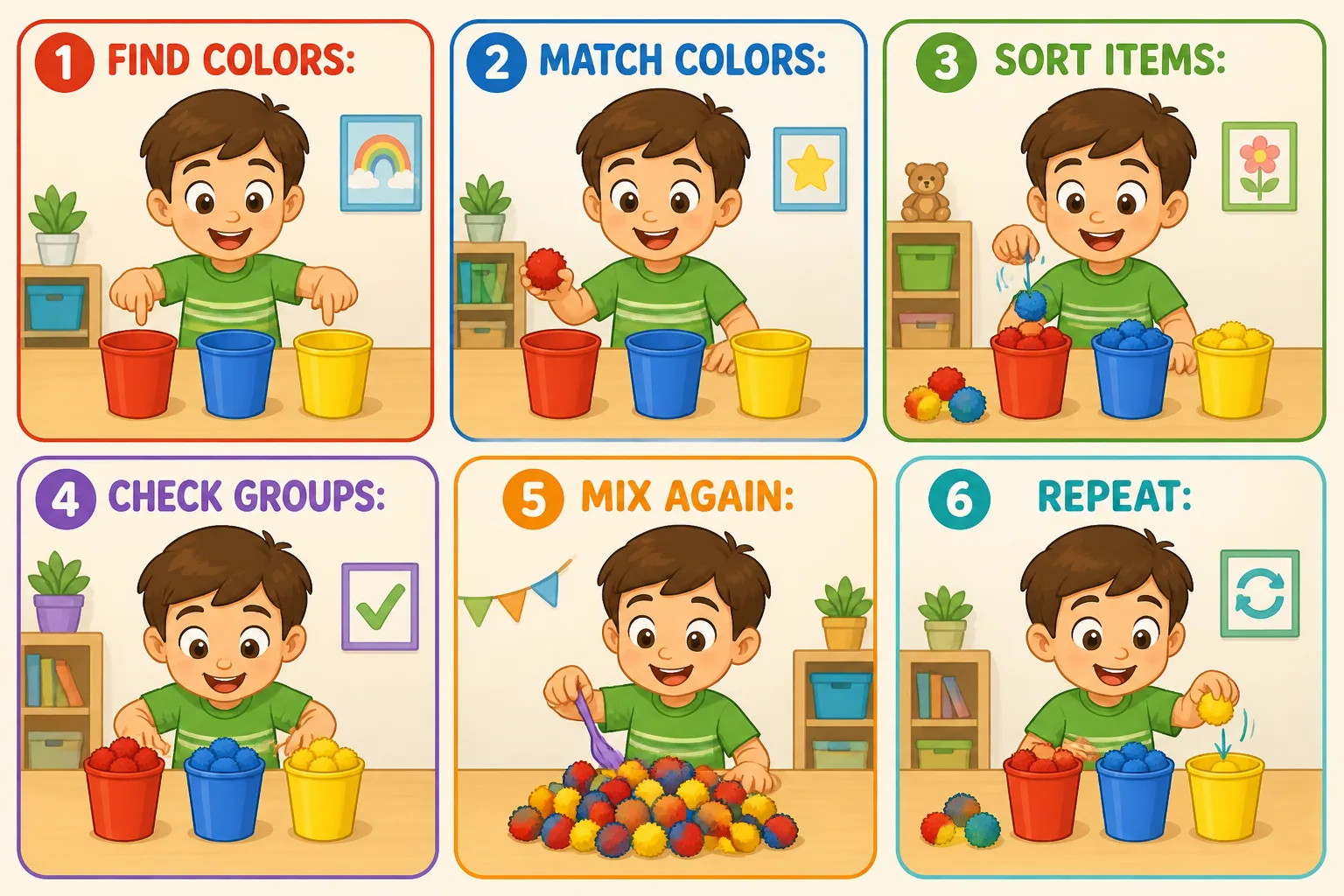
Simple Color Sorting is a playful and educational activity that helps young children develop important skills such as color recognition, sorting, fine motor control, and problem solving. This activity is perfect for toddlers and preschoolers, including children who benefit from additional developmental support. Using colorful cups and matching pom-poms or small balls, children practice matching colors and sorting objects, which builds foundational cognitive skills and hand-eye coordination.

Steps for Simple Color Sorting

1. Find Colors

Start by showing your child three colorful cups—red, blue, and yellow. Encourage them to point to or name each color. This introduces color recognition in a fun, interactive way.

2. Match Colors

Give your child pom-poms or small balls in the same colors as the cups. Help them hold a pom-pom and match it to the cup of the same color. This step reinforces color matching and visual discrimination.

3. Sort Items

Invite your child to drop each pom-pom into the matching cup. This action promotes fine motor skills and hand-eye coordination as they grasp and release the objects.

4. Check Groups

Encourage your child to look inside each cup and count or notice the pom-poms. This helps develop early counting skills and attention to detail.

5. Mix Again

Pour all the pom-poms back onto the table and mix them up. This resets the activity and encourages repetition, which is key for learning.

6. Repeat

Invite your child to sort the pom-poms again, practicing the skills they’ve just learned. Repetition builds confidence and mastery.

How Parents Can Play Together

Set up the cups and pom-poms on a low table or floor space. Model each step slowly, using simple language like “Find red,” “Put red here.” Give your child plenty of time to explore and try each step. Celebrate their efforts and successes with smiles and praise. Keep the mood light and playful, and follow your child’s interest and pace.

Simple Adaptation

Easier: Use only two colors and fewer pom-poms to reduce choices and complexity.
Harder: Add more colors or ask your child to count pom-poms as they sort. You can also introduce sorting by size or texture for added challenge.

This activity supports early learning through play by combining color recognition, sorting, fine motor practice, and problem solving in a joyful, accessible way.

Have you noticed your child’s favorite color to sort? Share your experience below!

For more fun learning activities, check out our Simple Nature Scavenger Hunt and Simple Cutting and Pasting activities.

Download the images in this article

  • Simple Color Sorting: A Fun Learning Through Play Activity

Tags:

color recognitionearly learningfine motor skillslearning through playsimple color sortingsorting activity
Author

Michelle Vu

Follow Me
Other Articles
My Doctor's Office Words
Previous

My Doctor’s Office Words

Understanding Autism Risk in Children of Unaffected Siblings
Next

Understanding Autism Risk in Children of Unaffected Siblings

No Comment! Be the first one.

Leave a Reply Cancel reply

Your email address will not be published. Required fields are marked *

ADHD ASD ASD research autism autism communication autism diagnosis autism parenting autism research autism spectrum disorder autism support autistic adults autistic children child communication child development child independence communication communication skills communication support communication supports communication tools coping strategies daily living skills early intervention emotional regulation fine motor skills Functional Communication intellectual disability language development learning through play mental health mouse model neurodevelopment neurodevelopmental disorders neurodiversity neuroinflammation parent advocacy positive behavior support sensory accommodations sensory needs sensory processing sensory support sex differences visual learning set visual routine young children

  • Halliwick Aquatic Therapy Linked to Improved Quality of Life in Children with
    Halliwick Aquatic Therapy Linked to Improved Quality of Life in Children with Autism Spectrum Disorder
    A study suggests that Halliwick-based aquatic physical activity may improve quality of life in children and adolescents with autism spectrum disorder, showing benefits in psychological well-being and autonomy.
  • New Insights into Autism: Linking Brain Fluid Dynamics and Network Development to
    New Insights into Autism: Linking Brain Fluid Dynamics and Network Development to Clinical Outcomes
    New research explores how brain fluid movement and neural network development may influence autism's clinical outcomes, offering insights into its diverse trajectories.
  • Study Links Perceived Stress and Auditory Sensitivity in Autistic and Non-Autistic University
    Study Links Perceived Stress and Auditory Sensitivity in Autistic and Non-Autistic University Students
    A study finds perceived stress is linked to auditory sensitivity in autistic and non-autistic university students, with autistic students showing higher sensitivity.
  • New Study Supports Reliable Autism Intervention Measures Across Clinic and Home Settings
    New Study Supports Reliable Autism Intervention Measures Across Clinic and Home Settings
    A recent study found that brief observational tools measuring social communication and caregiver strategies in young autistic children are reliable and feasible across both clinic and home settings, supporting flexible early intervention assessments.
  • Study Highlights Social Disadvantages Impacting Health of Autistic Adults Without Intellectual Disability
    Study Highlights Social Disadvantages Impacting Health of Autistic Adults Without Intellectual Disability
    A UK study finds autistic adults without intellectual disability face social disadvantages that contribute to higher chronic illness and mortality risks, highlighting the need for systemic policy changes.
Simple Shape Stacking: A Fun Learning Through Play Activity
September 26, 2026
Simple Nature Scavenger Hunt: A Fun Learning Through Play Activity
September 22, 2026
Simple Cutting and Pasting: A Fun Learning Through Play Activity
September 19, 2026
Simple Sticker Sorting and Matching: A Fun Learning Through Play Activity
September 17, 2026
Study Reveals Sex-Specific Behavioral Changes in Mice Lacking α5-Nicotinic Acetylcholine Receptors
157 views
Preparing for Loud Events: 6 Sensory Support Steps for Children
139 views
Expressing Discomfort and Asking for Help: 6 Essential Communication Phrases for Young
Expressing Discomfort and Asking for Help: 6 Essential Communication Phrases for Young Children
133 views
Feeling Worried: 6 Steps to Help Young Children Recognize and Manage Worry
131 views
Using a Calm Voice: 5 Positive Steps for Young Children
129 views

Content on this website is created with the assistance of artificial intelligence (AI), while some portions are still reviewed and overseen by humans. All content and resources are provided completely free of charge.

Some information may be referenced or cited from reputable sources. Whenever possible, we will clearly identify the sources used within each article.

If you have any questions, feedback, or would like to contact us, please email: info@autismwords.com

Copyright 2026 — Love Beyond Words - autismwords.com. All rights reserved. Blogsy WordPress Theme

Join Us on the Journey to Understanding Autism

Subscribe to receive curated autism knowledge, lessons, and the latest news — delivered to you regularly.

We promise to send only helpful autism-related information and knowledge — no ads, no spam. You can unsubscribe anytime.

Thank you for subscribing!