
Hero News

October 16, 2026
Halliwick Aquatic Therapy Linked to Improved Quality of Life in Children with Autism Spectrum Disorder
A study suggests that Halliwick-based aquatic physical activity may improve quality of life in children and adolescents with autism spectrum disorder, showing benefits in psychological well-being and autonomy.

October 16, 2026
New Insights into Autism: Linking Brain Fluid Dynamics and Network Development to Clinical Outcomes
New research explores how brain fluid movement and neural network development may influence autism's clinical outcomes, offering insights into its diverse trajectories.

October 16, 2026
Study Links Perceived Stress and Auditory Sensitivity in Autistic and Non-Autistic University Students
A study finds perceived stress is linked to auditory sensitivity in autistic and non-autistic university students, with autistic students showing higher sensitivity.

October 16, 2026
New Study Supports Reliable Autism Intervention Measures Across Clinic and Home Settings
A recent study found that brief observational tools measuring social communication and caregiver strategies in young autistic children are reliable and feasible across both clinic and home settings, supporting flexible early intervention assessments.

October 15, 2026
Study Highlights Social Disadvantages Impacting Health of Autistic Adults Without Intellectual Disability
A UK study finds autistic adults without intellectual disability face social disadvantages that contribute to higher chronic illness and mortality risks, highlighting the need for systemic policy changes.
October 15, 2026
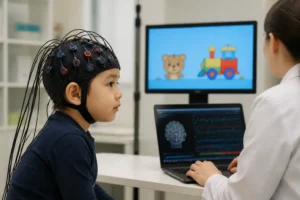
Exploratory Study Uses fNIRS and Machine Learning to Differentiate Autism in Young Children
A study explored using functional near-infrared spectroscopy (fNIRS) with machine learning to classify autism in children aged 2-6, finding modest accuracy and no significant diagnostic advantage beyond age and sex.

October 15, 2026
New Framework Introduced to Evaluate Autism Support Through a Neurodiversity-Affirming Lens
A new five-principle framework offers a way to evaluate autism support research that respects neurodiversity, focusing on strengths, autonomy, communication, and sensory differences.