
Skip to content
-
Subscribe to our newsletter & never miss our best posts. Subscribe Now!
Love Beyond Words - autismwords.com Love Beyond Words - autismwords.com Love Beyond Words - autismwords.com

Supporting children with autism through education and care

Love Beyond Words - autismwords.com Love Beyond Words - autismwords.com Love Beyond Words - autismwords.com

Supporting children with autism through education and care

  • Learning & Support
    • Communication Skills
    • Daily Living Skills
    • Emotional Regulation
    • Everyday Challenges
    • Learning Through Play
    • Parent Education & Advocacy
    • Positive Behavior Support
    • Routines & Transitions
    • Social Skills
    • Speech & Language
  • Autism News & Perspectives
  • Learning & Support
    • Communication Skills
    • Daily Living Skills
    • Emotional Regulation
    • Everyday Challenges
    • Learning Through Play
    • Parent Education & Advocacy
    • Positive Behavior Support
    • Routines & Transitions
    • Social Skills
    • Speech & Language
  • Autism News & Perspectives
Close

Search

  • https://www.facebook.com/
  • https://twitter.com/
  • https://t.me/
  • https://www.instagram.com/
  • https://youtube.com/
Subscribe
Love Beyond Words - autismwords.com Love Beyond Words - autismwords.com Love Beyond Words - autismwords.com

Supporting children with autism through education and care

Love Beyond Words - autismwords.com Love Beyond Words - autismwords.com Love Beyond Words - autismwords.com

Supporting children with autism through education and care

  • Learning & Support
    • Communication Skills
    • Daily Living Skills
    • Emotional Regulation
    • Everyday Challenges
    • Learning Through Play
    • Parent Education & Advocacy
    • Positive Behavior Support
    • Routines & Transitions
    • Social Skills
    • Speech & Language
  • Autism News & Perspectives
  • Learning & Support
    • Communication Skills
    • Daily Living Skills
    • Emotional Regulation
    • Everyday Challenges
    • Learning Through Play
    • Parent Education & Advocacy
    • Positive Behavior Support
    • Routines & Transitions
    • Social Skills
    • Speech & Language
  • Autism News & Perspectives
Close

Search

  • https://www.facebook.com/
  • https://twitter.com/
  • https://t.me/
  • https://www.instagram.com/
  • https://youtube.com/
Subscribe
Home/Autism News & Perspectives/Hidden Markov Models Reveal Distinct Brain Network Dynamics in Autism Spectrum Disorder
Hidden Markov Models Reveal Distinct Brain Network Dynamics in Autism Spectrum Disorder
Autism News & Perspectives

Hidden Markov Models Reveal Distinct Brain Network Dynamics in Autism Spectrum Disorder

August 22, 2026 2 Min Read
0

New Insights into Autism Brain Connectivity Using Advanced Imaging Analysis

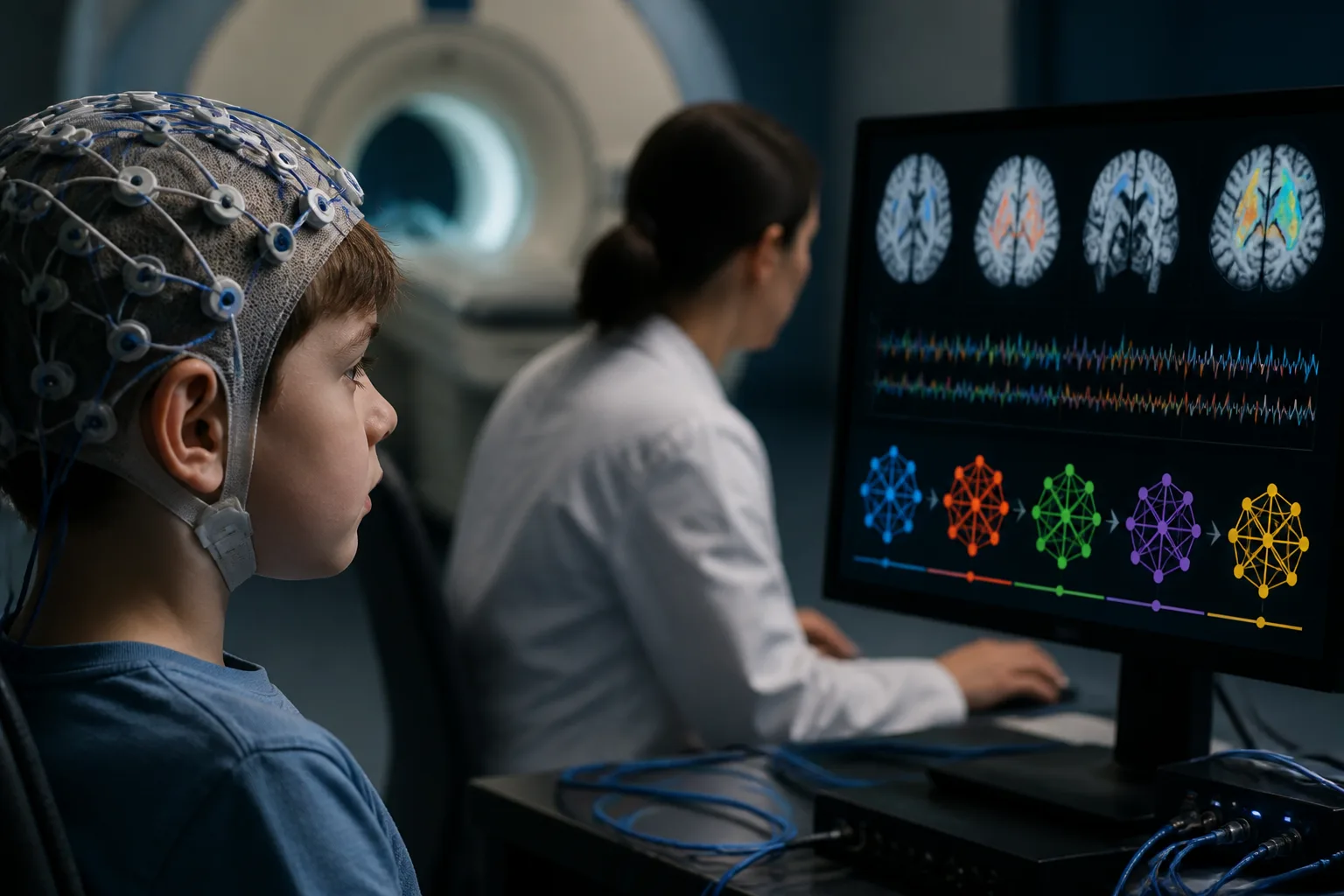
Recent research has applied Hidden Markov Models (HMMs) to resting-state functional MRI (rs-fMRI) data to better understand brain network dynamics in individuals with autism spectrum disorder (ASD). This approach captures the temporal fluctuations of brain activity more effectively than traditional static connectivity methods, offering fresh perspectives on the neural mechanisms underlying ASD.

Systematic Review and Meta-Analysis Findings

A systematic review and meta-analysis published online ahead of print in Journal of Autism and Developmental Disorders synthesized data from seven peer-reviewed studies that used HMMs on rs-fMRI in ASD populations. The analysis demonstrated that HMM-derived metrics have strong diagnostic potential, with a pooled area under the curve (AUC) of 0.85, indicating good accuracy in distinguishing individuals with ASD from typically developing controls.

Key findings revealed that people with ASD exhibit significantly reduced mean lifetime (MLT) and fractional occupancy (FO) in brain states associated with the default mode network (DMN), which is involved in integrative cognitive processes. Conversely, these individuals showed prolonged MLT and increased FO in states linked to sensory and attention networks, suggesting heightened and more persistent activation in these areas.

Brain Network Dynamics in ASD

The DMN-related states, which typically support social cognition and self-referential thought, were less engaged in ASD participants. In contrast, sensory and attention networks demonstrated hyperactivation and longer persistence. Transition analyses indicated fewer shifts from sensory to DMN states and more repetitive activity within sensory-motor states, reflecting a pattern of rigid brain dynamics.

Clinical Correlations and Implications

Importantly, these HMM metrics correlated negatively with Autism Diagnostic Observation Schedule (ADOS) scores, suggesting that more pronounced alterations in brain dynamics align with greater symptom severity. This supports the potential of HMM-based rs-fMRI analysis as a tool for personalized diagnostics and understanding the neural basis of ASD.

Considerations and Limitations

Despite promising results, the studies included showed substantial heterogeneity in methodology, such as differences in brain atlases, number of HMM states modeled, and participant characteristics. Risk of bias was generally low to moderate, with some studies not fully adjusting for confounding variables. These factors highlight the need for standardized protocols in future research to enhance comparability and clinical applicability.

Conclusion

This meta-analysis underscores that ASD is characterized by imbalanced and inflexible temporal brain dynamics, marked by diminished engagement of integrative networks and dominance of sensory-related activity. Hidden Markov Models applied to rs-fMRI provide a valuable framework for capturing these complex patterns, offering pathways toward improved mechanistic understanding and individualized diagnostic strategies.

For more detailed information, see the original publication: Autism Spectrum Disorder Through the Lens of Hidden Markov Models Applied to Resting-State fMRI.

Download the images in this article

  • Hidden Markov Models Reveal Distinct Brain Network Dynamics in Autism Spectrum Disorder

Tags:

ASD brain dynamicsautism spectrum disorderbrain networksdefault mode networkdiagnostic imagingHidden Markov Modelsresting-state fMRIsensory processing
Other Articles
Un avance técnico revolucionario para el estudio de la memoria: la experiencia
Previous

Un avance técnico revolucionario para el estudio de la memoria: la experiencia de Noela Weisstaub

2023 Advances in Autism Research Highlight Diagnosis, Gender Differences, and Genetic Insights
Next

2023 Advances in Autism Research Highlight Diagnosis, Gender Differences, and Genetic Insights

No Comment! Be the first one.

Leave a Reply Cancel reply

Your email address will not be published. Required fields are marked *

AAC asking for a break asking for help autism education autism parenting autism parenting tips autism research Autism Science Foundation autism spectrum disorder autism support child development child independence communication communication phrases communication skills coping strategies daily living skills documenting progress early childhood development emotional regulation fine motor skills hygiene routine independence language development learning through play neuroscience parent advocacy parenting tips parent preparation patience for children positive behavior support problem solving replacement skills self-advocacy self-regulation sensory sensitivities sensory support shape recognition snack time routine special education speech and language step-by-step routine visual learning visual learning set young children

  • How Clear Communication Helps Secure Classroom Accommodations for Your Autistic Child
    How Clear Communication Helps Secure Classroom Accommodations for Your Autistic Child
    Clear communication with teachers helps parents secure effective classroom accommodations through the IEP process for their autistic child.
  • Tracking Concerns About My Child: 6 Practical Parent Steps
    Tracking Concerns About My Child: 6 Practical Parent Steps
    Learn 6 practical steps for parents to track concerns about their child effectively. Observe, document, and identify patterns to support advocacy and collaboration with professionals.
  • When I Make a Mistake: 6 Steps to Help Kids Cope
    When I Make a Mistake: 6 Steps to Help Kids Cope
    Help your child cope with mistakes using 6 practical steps: notice, pause, ask for help, fix what I can, try again, and move on. Support emotional growth with these strategies.
  • When I'm Excited: 6 Steps to Recognize and Manage Excitement in Young
    When I’m Excited: 6 Steps to Recognize and Manage Excitement in Young Children
    Help your child recognize and manage excitement with 6 simple steps: notice body signals, say "I'm excited," communicate safely, choose safe actions, ask for help, and take breaks.
  • Study Highlights Ways to Reduce Emotional Strain for Neurodivergent Students in Schools
    Study Highlights Ways to Reduce Emotional Strain for Neurodivergent Students in Schools
    A recent study reveals key factors contributing to emotional challenges faced by neurodivergent students in schools and highlights strategies involving both students and staff to foster supportive environments.
Study Highlights Ways to Reduce Emotional Strain for Neurodivergent Students in Schools
August 22, 2026
Avanço técnico em estudos da memória destaca reativação neuronal durante a recuperação
August 22, 2026
2023 Advances in Autism Research Highlight Diagnosis, Gender Differences, and Genetic Insights
August 22, 2026
Un avance técnico revolucionario para el estudio de la memoria: la experiencia
Un avance técnico revolucionario para el estudio de la memoria: la experiencia de Noela Weisstaub
August 22, 2026
Preparing for Loud Events: 6 Sensory Support Steps for Children
41 views
Expressing Discomfort and Asking for Help: 6 Essential Communication Phrases for Young
Expressing Discomfort and Asking for Help: 6 Essential Communication Phrases for Young Children
39 views
Using a Calm Voice: 5 Positive Steps for Young Children
30 views
Transition from Playtime to Snack Time: 6-Step Visual Routine for Young Children
27 views
Preparing for an IEP Meeting: 6 Essential Parent Steps for Success
26 views

Content on this website is created with the assistance of artificial intelligence (AI), while some portions are still reviewed and overseen by humans. All content and resources are provided completely free of charge.

Some information may be referenced or cited from reputable sources. Whenever possible, we will clearly identify the sources used within each article.

If you have any questions, feedback, or would like to contact us, please email: info@autismwords.com

Copyright 2026 — Love Beyond Words - autismwords.com. All rights reserved. Blogsy WordPress Theme

Cùng đồng hành trên hành trình hiểu về Tự Kỷ

Đăng ký để nhận kiến thức, bài học và tin tức mới nhất về tự kỷ — được chọn lọc và gửi đến bạn đều đặn.

Chúng tôi cam kết chỉ gửi thông tin và kiến thức hữu ích về tự kỷ — không quảng cáo, không spam. Bạn có thể hủy đăng ký bất cứ lúc nào.

Cảm ơn bạn đã đăng ký!