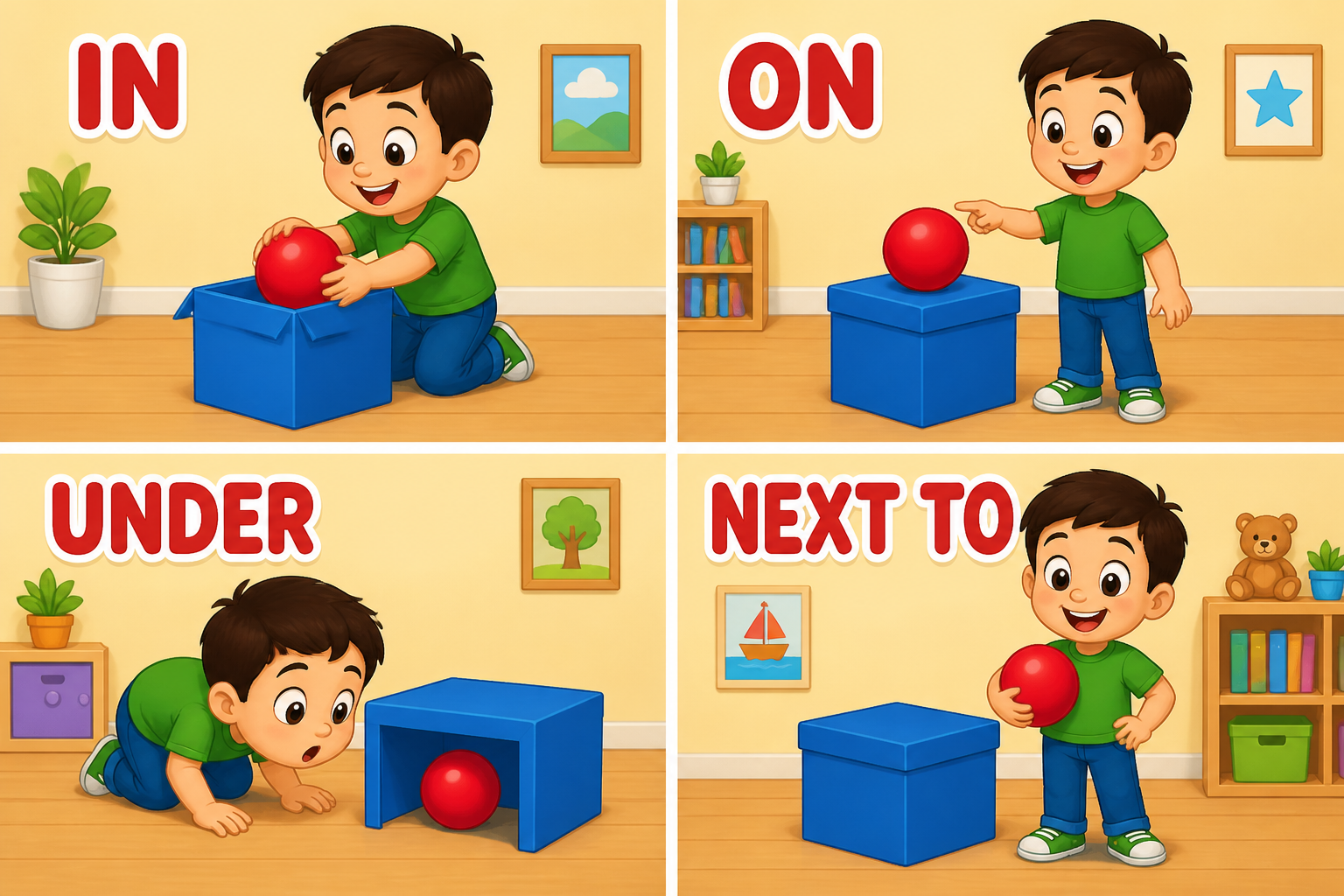

Understanding prepositions is a key step in developing children’s language skills. This visual learning post focuses on four common prepositions: IN, ON, UNDER, and NEXT TO. These words help children describe where objects are located and are essential for everyday communication.
Why Teach Prepositions?
Prepositions describe spatial relationships between objects and people. Mastering them supports children’s ability to follow directions, describe scenes, and build more complex sentences. For example, saying “The ball is under the box” gives clear information about location.
Four Key Prepositions with Visual Examples
1. IN
The child puts the ball in the box. This shows the ball is inside the box, surrounded by it.
2. ON
The child places the ball on the box. Here, the ball rests on the surface of the box.
3. UNDER
The child looks under the box where the ball is hidden, illustrating the ball’s position below the box.
4. NEXT TO
The child stands next to the box holding the ball, showing that the ball and child are beside the box.
How Parents Can Practice These Prepositions
- Name the action: “The ball is in the box!”
- Model short phrases: “Ball on box.”
- Ask simple questions: “Where is the ball?”
- Give choices: “Is the ball on or under the box?”
- Use everyday objects: Boxes, cups, toys, or books work well.
- Accept all responses: Pointing, gestures, or words are great!
Encouraging Language Growth
Repeat these words naturally during play and routines. Expand your child’s language by adding words or short sentences. For example, if your child says “ball,” you can say “Yes, the ball is on the box!” This helps build vocabulary and sentence skills without pressure.
Try this fun activity and watch your child’s understanding of location words grow!
Parent question: What other objects can you find to practice “in,” “on,” “under,” and “next to” at home?
Download de afbeeldingen in dit artikel